

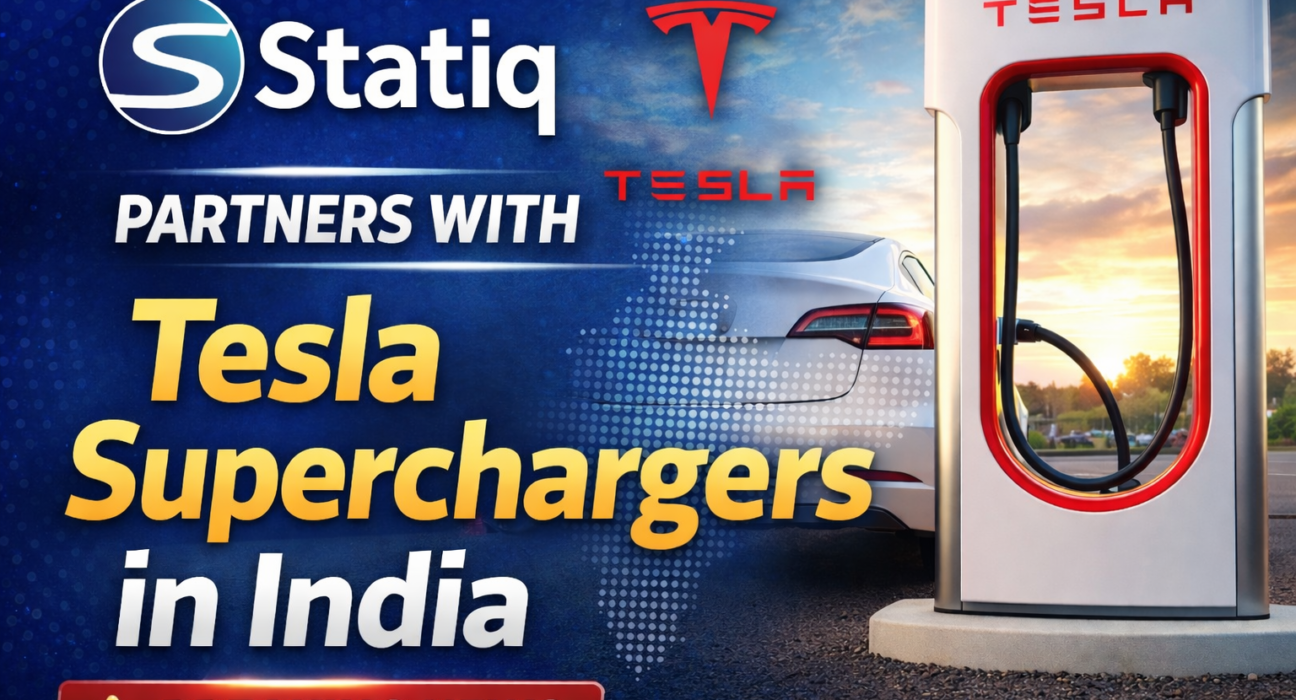
India’s electric vehicle charging ecosystem has reached an important milestone with Statiq partnering with Tesla for the development of Tesla Supercharger infrastructure in India.
According to industry reports and verified LinkedIn disclosures, Statiq has been appointed as the Engineering, Procurement, and Construction (EPC) partner for upcoming Tesla Supercharger sites in the country.
While Tesla has not yet launched vehicle sales in India, this partnership signals serious groundwork for high-power EV charging deployment, aligned with India’s long-term electric mobility roadmap.
What Is Confirmed About the Statiq–Tesla Partnership
The partnership is infrastructure-focused, not a vehicle launch announcement.
Key confirmed points:
- Statiq is working with Tesla as an EPC partner
- Statiq’s role includes:
- Site engineering
- Electrical and civil execution
- Procurement and installation
- Commissioning support
- Tesla retains ownership and control of:
- Supercharger hardware
- Network software
- Charging protocols and access policies
This mirrors Tesla’s global approach, where local EPC partners execute infrastructure, while Tesla controls the charging ecosystem.
What Tesla Superchargers Typically Involve
Globally, Tesla Superchargers are known for:
- DC fast charging capability (typically 250 kW, with higher capacities in newer deployments)
- High uptime and redundancy
- Integrated software-based monitoring
- Optimized charging curves for fast turnaround
If deployed in India, these chargers would represent a new tier of high-power charging infrastructure, especially compared to the current 30–120 kW DC public charging norm.
Why Tesla Chose Statiq
Statiq has emerged as one of India’s most execution-capable charging infrastructure companies.
Statiq’s existing footprint:
- 7,000+ EV charging points
- Presence across 60+ cities
- Mix of AC and DC chargers
- Experience with:
- Highway locations
- Commercial hubs
- Fleet and OEM partnerships
For a global OEM like Tesla, local execution reliability, grid coordination, and regulatory familiarity matter more than just charger count — areas where Statiq already has proven experience.
Why This Partnership Is Strategically Important for India
1. High-Power Charging Finally Enters the Picture
Most Indian public chargers today operate below 100 kW. Tesla Superchargers bring true ultra-fast charging standards, which are critical for:
- Premium EVs
- Long-distance highway travel
- Fleet-grade uptime expectations
2. Raises the Infrastructure Benchmark
Tesla’s charging standards set higher expectations for reliability, safety, and performance, which often pushes the entire ecosystem to improve.
3. Signals OEM Confidence in Indian Infrastructure
Tesla appointing an Indian EPC partner indicates confidence in India’s grid readiness, compliance framework, and execution capability — something that was missing even a few years ago.
What This Does NOT Mean (Important Clarification)
To avoid misinformation, it’s important to clarify what this partnership does not confirm:
- It does not confirm Tesla car sales in India
- It does not mean Superchargers will be open to all EV brands
- It does not indicate timelines for public rollout
This is an infrastructure preparation step, not a commercial vehicle launch announcement.
How This Fits Into India’s EV Policy Direction
India’s current EV policy focus (PM E-DRIVE scheme) strongly supports:
- Charging infrastructure
- Commercial EV adoption
- Grid-ready deployments
- Private sector execution
The Statiq–Tesla collaboration fits directly into this framework, especially as the government pushes for:
- Highway charging corridors
- High-capacity urban charging
- Private investment in EV infra
What This Means for the EV Industry
For EV ecosystem stakeholders, this partnership indicates:
- India is ready for global-grade charging infrastructure
- EPC capability has matured
- Charging infra is moving beyond “basic availability” to performance and reliability
Even if Tesla’s chargers remain brand-specific initially, the spillover impact on standards, execution quality, and expectations will benefit the wider EV ecosystem.
Conclusion
The Statiq–Tesla partnership is a quiet but powerful signal.
It shows that:
- Global EV leaders are preparing infrastructure in India
- Indian charging companies are trusted at global standards
- The EV charging conversation is shifting from quantity to quality
This is not hype — it’s infrastructure groundwork, and infrastructure always comes before scale.
If you want next:
- A LinkedIn authority post on this news
- A neutral explainer comparing Tesla Superchargers vs Indian DC fast chargers
- A charging infra trend article for 2026
Just tell me what to create next.