

When fleet operators evaluate electric trucks in India, the conversation usually stops at purchase price and subsidy. That is not how commercial vehicle decisions are made.
What actually matters is Total Cost of Ownership (TCO) — the complete cost of owning, running, and maintaining a truck over its working life.
This article breaks down the real 5-year TCO of an electric truck vs a diesel truck in India, using practical operating assumptions, real electricity and fuel economics, and fleet-level cost components that are often ignored.
No hype. Only ground reality.
What Is TCO (Total Cost of Ownership)?
TCO includes every rupee spent from the day the vehicle is purchased until it is sold or scrapped.
For trucks, TCO typically includes:
• Vehicle purchase cost (after subsidy)
• Registration, insurance, and permits
• Fuel or electricity
• Routine servicing and maintenance
• Wear parts (clutch, brakes, filters, oils)
• Charging infrastructure (for EVs)
• Battery replacement (if applicable)
• Downtime and productivity loss
• Resale value at end of life
Only when these are combined can two vehicles be compared fairly.
Case Study Framework (Used in This Article)
To make this comparison realistic, we evaluate a typical 1–1.5 ton urban logistics truck — the segment where EV adoption is currently fastest in India.
Operating Profile
| Parameter | Value |
|---|---|
| Daily running | 120 km |
| Working days | 26 days/month |
| Annual distance | ~37,000 km |
| Ownership period | 5 years |
| Total distance (5 years) | ~1,85,000 km |
This reflects e-commerce, FMCG, city distribution, municipal fleets, and warehouse operations.
Vehicle Assumptions
Electric Truck (1–1.5 Ton Class)
• Ex-showroom price: ₹16.5 lakh
• Government subsidy (effective): ₹3.0 lakh
• Net purchase cost: ₹13.5 lakh
• Battery: 30–40 kWh
• Real-world efficiency: 1.1–1.3 km/kWh (loaded, urban use)
• Electricity tariff (commercial): ₹7 per kWh
• Service interval: 10,000–15,000 km
• Battery warranty: 5 years / 1.5–2 lakh km
• Expected resale after 5 years: ₹5.5–6.5 lakh
Diesel Truck (1–1.5 Ton Class)
• Ex-showroom price: ₹10.5 lakh
• Fuel efficiency (real): 10–12 km/litre
• Diesel price (commercial average): ₹90/litre
• Major maintenance: clutch, engine oil, filters, injectors
• Expected resale after 5 years: ₹4.5–5.5 lakh
1️⃣ Upfront Cost Comparison
| Cost Component | Electric Truck | Diesel Truck |
|---|---|---|
| Ex-showroom | ₹16.5 lakh | ₹10.5 lakh |
| Subsidy | – ₹3.0 lakh | Not applicable |
| Registration, insurance, permits | ₹1.0 lakh | ₹1.0 lakh |
| Total Initial Cost | ₹14.5 lakh | ₹11.5 lakh |
🔎 Observation:
EV still costs ~₹3 lakh more upfront, even after subsidy.
2️⃣ Energy / Fuel Cost Over 5 Years
Electric Truck
• Average efficiency: 1.2 km/kWh
• Annual consumption: 37,000 ÷ 1.2 ≈ 30,800 kWh/year
• Electricity cost: 30,800 × ₹7 ≈ ₹2.15 lakh/year
• 5-year electricity cost: ₹10.75 lakh
Diesel Truck
• Average mileage: 11 km/litre
• Annual fuel: 37,000 ÷ 11 ≈ 3,360 litres/year
• Diesel cost: 3,360 × ₹90 ≈ ₹3.02 lakh/year
• 5-year fuel cost: ₹15.1 lakh
Energy Cost Comparison
| Category | Electric | Diesel |
|---|---|---|
| Annual | ₹2.15 lakh | ₹3.02 lakh |
| 5-Year Total | ₹10.75 lakh | ₹15.10 lakh |
⚡ EV saves ~₹4.35 lakh in energy alone over 5 years
3️⃣ Maintenance & Service Cost
Electric trucks eliminate many high-wear components:
• No engine oil
• No gearbox oil
• No clutch
• Fewer filters
• Regenerative braking reduces brake wear
Estimated Maintenance Cost
| Item | Electric | Diesel |
|---|---|---|
| Annual servicing | ₹15,000 | ₹40,000 |
| Major repairs (5 years) | ₹50,000 | ₹1.5 lakh |
| Total (5 years) | ₹1.25 lakh | ₹3.5 lakh |
🔧 EV saves ~₹2.25 lakh in maintenance
4️⃣ Charging Infrastructure Cost (Often Ignored)
EV ownership is not only about the vehicle.
Assume a private depot charger:
• 15–30 kW AC/DC charger
• Electrical panel upgrades
• Cabling and civil work
One-Time Cost
| Component | Cost |
|---|---|
| Charger hardware | ₹1.5–2.5 lakh |
| Installation & electrical upgrades | ₹1.0 lakh |
| Total | ₹2.5–3.5 lakh |
Assuming one charger supports 3–4 trucks, the per-vehicle infrastructure cost ≈ ₹1 lakh
5️⃣ Battery Replacement (Reality Check)
Most OEMs now offer:
• 5-year / 1.5–2 lakh km battery warranty
• Performance guarantees (typically 70–80% SOH)
Under normal urban operations:
✔ Battery replacement usually not required within 5 years
✔ Degradation affects range, not operability
✔ Many fleets extend usage with reduced daily range
For conservative accounting:
• Battery reserve cost: ₹0 (within warranty)
6️⃣ Resale Value After 5 Years
| Vehicle Type | Expected Resale |
|---|---|
| Electric Truck | ₹5.5–6.5 lakh |
| Diesel Truck | ₹4.5–5.5 lakh |
🔁 EV retains higher value due to lower mechanical wear and usable battery life.
7️⃣ Full 5-Year TCO Comparison
Electric Truck (5 Years)
| Cost Head | Amount |
|---|---|
| Initial cost | ₹14.5 lakh |
| Electricity | ₹10.75 lakh |
| Maintenance | ₹1.25 lakh |
| Charging infra (allocated) | ₹1.0 lakh |
| Gross Cost | ₹27.5 lakh |
| Less resale value | – ₹6.0 lakh |
| Net 5-Year TCO | ₹21.5 lakh |
Diesel Truck (5 Years)
| Cost Head | Amount |
|---|---|
| Initial cost | ₹11.5 lakh |
| Diesel | ₹15.1 lakh |
| Maintenance | ₹3.5 lakh |
| Gross Cost | ₹30.1 lakh |
| Less resale value | – ₹5.0 lakh |
| Net 5-Year TCO | ₹25.1 lakh |
📊 Final Result
| Metric | Electric | Diesel |
|---|---|---|
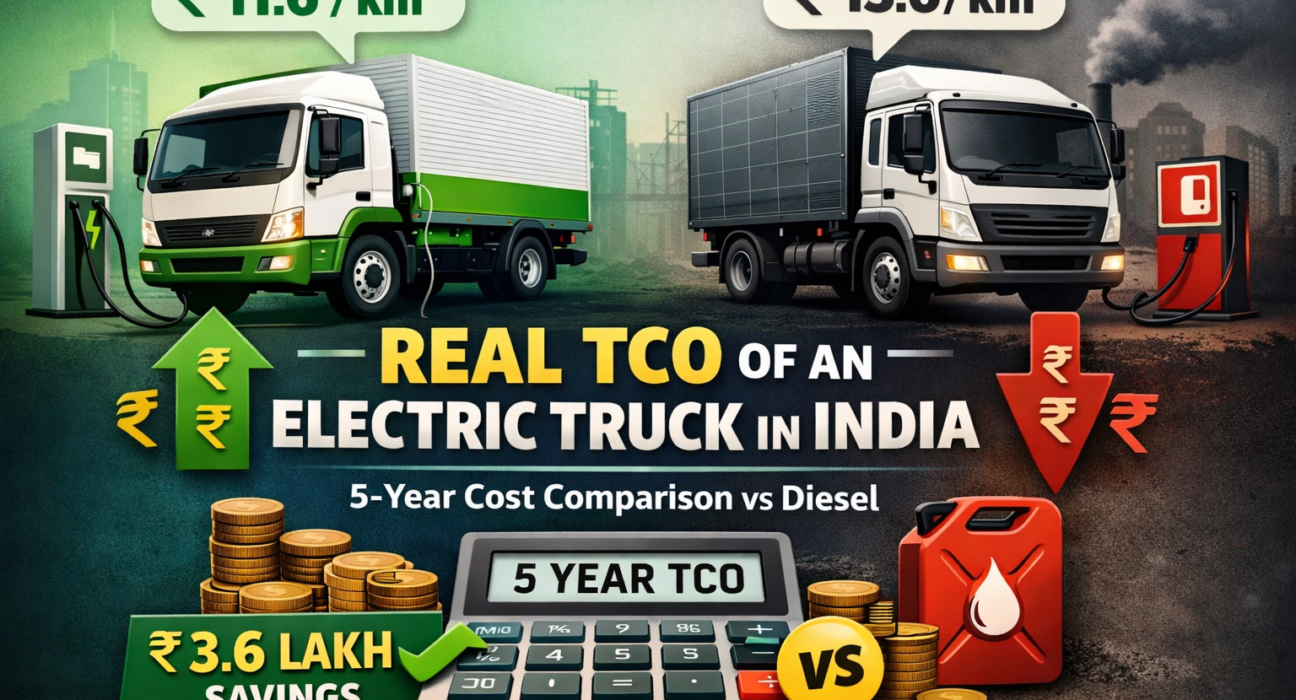
| 5-Year Net TCO | ₹21.5 lakh | ₹25.1 lakh |
| Cost per km | ₹11.6/km | ₹13.6/km |
| Savings | ₹3.6 lakh | — |
⚡ Electric truck is ~14–18% cheaper over 5 years
8️⃣ Break-Even Point (When EV Becomes Cheaper)
Upfront difference: ~₹3 lakh
Annual operating savings:
• Energy: ₹87,000
• Maintenance: ₹45,000
• Total: ~₹1.3 lakh/year
👉 Break-even: ~2.2–2.5 years
After this point, every kilometer driven is net savings.
When EV TCO Makes Sense in India
Electric trucks deliver strong economics when:
✔ Daily running > 80 km
✔ Fixed urban or regional routes
✔ Private charging at depot
✔ Predictable loads
✔ High fuel and maintenance exposure
When Diesel Still Wins
Diesel may still be better if:
✘ Long-haul routes (300–800 km/day)
✘ No charging access
✘ Highly variable routes
✘ Frequent overloading
✘ Remote areas with weak power supply
Key Myths vs Reality
Myth: EVs are cheaper only because of subsidy
Reality: Operating cost advantage remains even without subsidy
Myth: Battery replacement will destroy economics
Reality: Warranty covers the typical 5-year fleet cycle
Myth: Public chargers are enough
Reality: Depot charging is what enables real ROI
Strategic Takeaway for Fleet Owners
Electric trucks are not “green experiments” anymore.
They are financial tools.
If your operation is urban, predictable, and high-utilization, an EV truck:
✔ Lowers cost per km
✔ Reduces downtime
✔ Improves compliance and sustainability
✔ Creates long-term operating leverage
But EVs are not universal replacements. They must be deployed where their economics actually work.
Frequently Asked Questions (FAQ)
Is EV cheaper than diesel without subsidy?
Yes. Subsidy improves payback speed, but fuel and maintenance savings alone create long-term cost advantage.
What is the biggest hidden cost in EV ownership?
Charging infrastructure and power upgrades, not the vehicle.
Does battery degradation affect resale?
Not significantly within 5 years. Many second-life and fleet buyers accept reduced range.
Can public charging replace depot charging?
No. Public chargers increase downtime and cost unpredictability.
Final Conclusion
A properly deployed electric truck in India saves ₹3–5 lakh over 5 years compared to diesel in urban logistics operations.
The decision is not emotional or environmental.
It is financial and operational.
Electric trucks are no longer the future —
they are already the smarter TCO choice for the right use-case.