

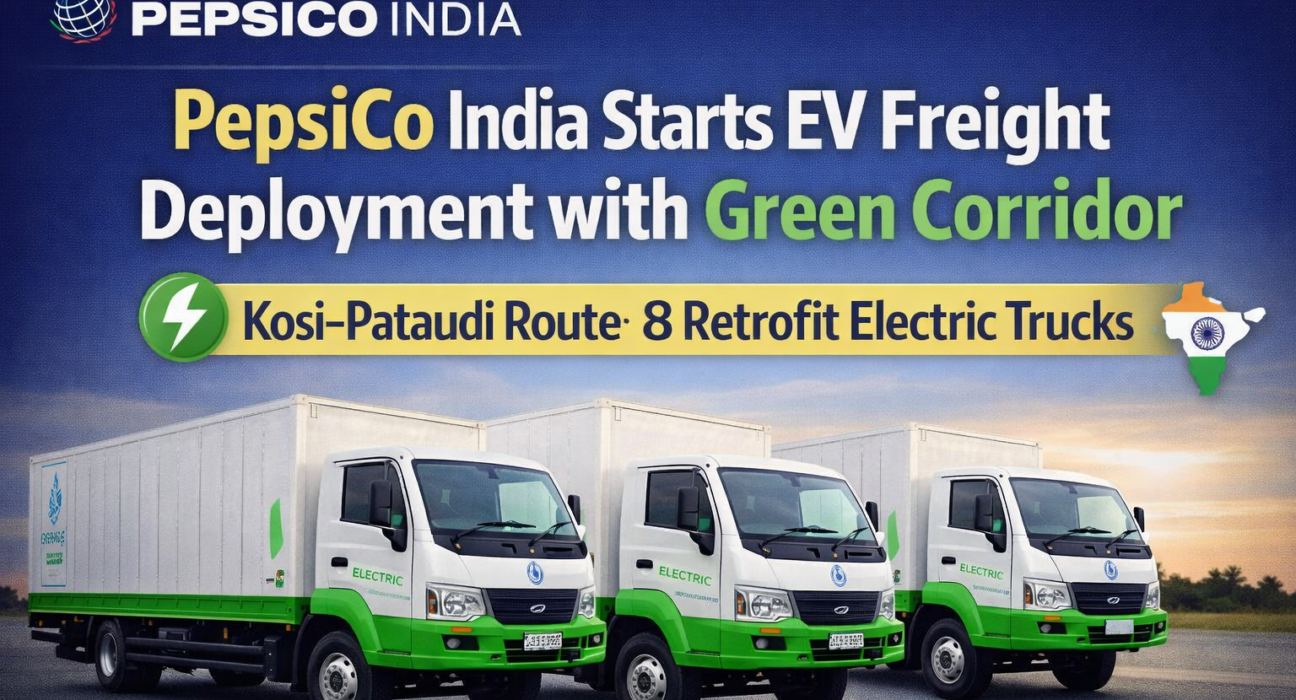
PepsiCo India Begins EV Freight Deployment with Green Corridor
PepsiCo India has launched a dedicated EV Green Corridor on the Kosi–Pataudi route, marking a significant step toward electrifying its logistics operations. However, this development should not be seen as a large-scale rollout yet. Instead, it represents a controlled, corridor-based deployment aimed at testing real-world feasibility.
At this stage, the focus is on execution and operational learning rather than volume expansion.
Why This Move Matters in India’s EV Logistics Space
India’s electric truck ecosystem is still at an early stage, especially in heavy and mid-size freight segments. Infrastructure limitations, high upfront costs, and range concerns continue to slow adoption.
In this context, PepsiCo India’s approach is important because it shifts the conversation from pilot testing to structured deployment. Rather than experimenting with a single vehicle, the company is implementing a defined logistics corridor where EV operations can be monitored and optimised.
EV Fleet and Deployment Details
The EV Green Corridor will operate with a fleet of eight electric container trucks on the Kosi–Pataudi route.
Key details include:
- Fleet size: 8 electric trucks
- Configuration: 32-feet single-axle container trucks
- Vehicle type: Re-powered electric trucks (retrofit conversion)
- Deployment route: Kosi to Pataudi
- Technology partner: Kalyani Powertrain Ltd
The use of re-powered trucks instead of brand-new OEM vehicles is a notable decision. It reflects a cost-efficient approach and suggests that retrofit solutions could play a major role in scaling electric freight in India.
India Angle: Corridor-Based EV Adoption Model
Unlike premium EV announcements that focus on specifications, this project is built around operational practicality.
A corridor-based model offers several advantages:
- Fixed routes allow better planning of charging infrastructure
- Predictable distances reduce range anxiety
- Retrofit vehicles lower capital investment
- Fleet utilisation can be optimised more efficiently
This approach aligns with how EV adoption is likely to evolve in India — starting with controlled corridors before expanding to wider networks.
Strategic Analysis: What This Signals
Shift from Pilot Projects to Scalable Models
The industry is moving beyond isolated pilot vehicles toward structured EV corridors. This indicates growing confidence in electric freight viability.
Rise of Retrofit EV Solutions
By using re-powered trucks, PepsiCo is highlighting a practical pathway for fleet operators. Instead of waiting for expensive new electric trucks, existing diesel vehicles can be converted, reducing entry barriers.
FMCG Sector as Early EV Adopter
FMCG companies are well-positioned to adopt electric logistics due to predictable routes and frequent movement cycles. Additionally, global sustainability commitments are pushing companies like PepsiCo to accelerate decarbonisation efforts.
Market Impact on India’s EV Truck Industry
While the scale of this deployment is currently limited, its implications are broader.
- More companies may adopt corridor-based EV logistics
- Demand for retrofit conversion solutions could increase
- Charging infrastructure may develop along freight routes rather than only in cities
This marks a shift from theoretical EV adoption to actual on-ground implementation in logistics operations.
Final Take
This development is not about the number of trucks deployed. It is about demonstrating that electric freight can work within India’s current infrastructure when applied strategically.
If replicated across multiple routes and industries, corridor-based EV deployment could become a foundational model for India’s transition toward sustainable logistics.