

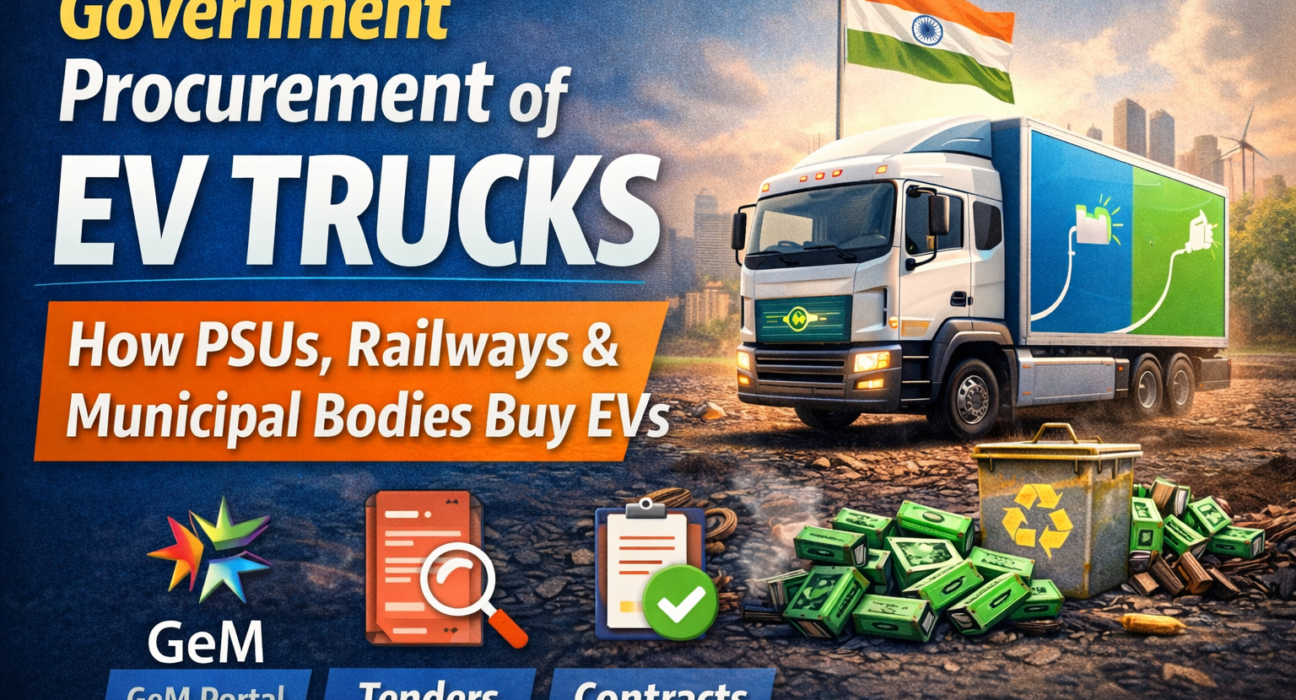
India’s transition to electric mobility is no longer limited to private fleets. Public Sector Undertakings (PSUs), Indian Railways, municipal corporations, and government departments are now actively procuring electric trucks for logistics, waste management, material handling, and intra-campus transport.
But how exactly does the government buy EV trucks? Who can sell to them? What portals, tenders, and compliance requirements are involved?
This article explains the complete procurement ecosystem for government EV truck purchases—from tenders and GeM to eligibility, pricing models, and delivery.
1. Why Government Procurement of EV Trucks Is Increasing
The Government of India is adopting EV trucks to meet:
• Net-zero and emission reduction targets
• Lower operating costs for public fleets
• Energy security by reducing diesel dependence
• Urban air quality goals
• Waste and logistics electrification
Typical use cases:
✔ Municipal waste collection & sanitation trucks
✔ Utility and PSU cargo vehicles
✔ Railways yard logistics & parcel movement
✔ Airport, port, and industrial estate operations
✔ In-plant movement for public sector factories
2. Who Buys EV Trucks in the Government System?
2.1 Public Sector Undertakings (PSUs)
Examples:
• NTPC
• BHEL
• Coal India
• ONGC
• Indian Oil / BPCL / HPCL
• GAIL
• SAIL
Use: internal logistics, maintenance fleets, cargo movement, and sustainability mandates.
2.2 Indian Railways & Metro Corporations
• Indian Railways
• DMRC (Delhi Metro)
• Metro Rail Corporations (Mumbai, Chennai, Bengaluru, etc.)
Use: parcel handling, yard logistics, station services, maintenance, and last-mile cargo.
2.3 Municipal Corporations & Urban Local Bodies (ULBs)
• Smart Cities
• Municipal Corporations
• Urban Development Authorities
Use: garbage collection, waste transport, street maintenance, water & sewerage operations.
2.4 Government Departments & Institutions
• Airports Authority of India
• Defence PSUs
• State Transport Departments
• Port Authorities
3. Main Procurement Channels for Government EV Trucks
Government bodies follow standard public procurement mechanisms, mainly through:
3.1 GeM Portal (Government e-Marketplace)
GeM is the primary procurement platform for most central and state government purchases.
How EV Trucks Are Bought on GeM:
✔ OEM or authorized dealer lists vehicle model
✔ Government buyer raises demand or compares products
✔ Purchase via:
• Direct Purchase (below threshold)
• L1 (lowest price) selection
• Bid / BOQ process for bulk orders
Key Advantage:
Transparent pricing, faster approval, and standardized documentation.
3.2 E-Tendering & Open Tenders
For large-scale or customized EV truck requirements, buyers issue tenders through:
• Central Public Procurement Portal (CPPP)
• State e-procurement portals
• PSU tender websites
Tender documents include:
✔ Technical specifications
✔ Quantity & delivery schedule
✔ Warranty & service requirements
✔ Charging infrastructure scope
✔ Compliance & certifications
3.3 Rate Contracts (RCs)
Some departments establish Rate Contracts with approved OEMs:
• Pre-approved pricing for a fixed period
• Faster ordering without repeated tenders
• Common in PSUs and Railways
3.4 Pilot & Demonstration Orders
Many agencies begin with:
• Pilot projects (5–20 vehicles)
• Proof-of-concept deployments
• Followed by scale-up after performance review
4. Step-by-Step: How a Government Body Procures EV Trucks
Step 1: Requirement Identification
Department defines:
✔ Vehicle category (mini truck, 3.5T, 7.5T, etc.)
✔ Application (waste, cargo, maintenance)
✔ Range, payload, body type
Step 2: Approval & Budget Sanction
• Internal approvals
• Sustainability or EV adoption targets
• Budget allocation
Step 3: Tender / GeM Listing
• Tender floated on portal or
• Vehicle selected via GeM marketplace
Step 4: Technical & Commercial Evaluation
✔ Battery specs
✔ Range under load
✔ Warranty (vehicle + battery)
✔ Charging compatibility
✔ Service network
Step 5: Order Award & Contract Signing
• L1 bidder or most suitable vendor selected
• Delivery timeline agreed
Step 6: Delivery, Commissioning & Inspection
• Vehicle inspection
• Compliance verification
• Registration & deployment
5. Eligibility: Who Can Sell EV Trucks to Government?
To participate in government procurement, sellers must:
✔ Be OEM or authorized dealer
✔ Be registered on GeM portal (if applicable)
✔ Have valid GST, PAN, and business registration
✔ Comply with:
• Automotive standards
• Battery safety norms
• Warranty & service obligations
✔ Meet tender technical criteria
6. Technical & Compliance Requirements
Government buyers typically mandate:
6.1 Vehicle Standards
✔ AIS / CMVR compliance
✔ Homologation certification
6.2 Battery & Safety
✔ Lithium-ion battery compliance
✔ Fire safety standards
✔ Battery warranty (usually 3–5 years)
6.3 After-Sales Support
✔ Service centers in operating region
✔ Spare parts availability
✔ AMC options
6.4 Charging Infrastructure
Some tenders require:
✔ On-site chargers
✔ Training of operators
✔ O&M support
7. Pricing Models in Government EV Truck Purchases
7.1 Outright Purchase
• Government pays full vehicle cost
• Most common model
7.2 Lease / Opex Model (Emerging)
• Monthly rental per vehicle
• Includes maintenance and sometimes charging
• Used in municipal & fleet pilots
7.3 Energy-as-a-Service (Selective Use)
• Vehicle + charging + maintenance bundled
• Growing in large city projects
8. Role of Subsidies in Government Procurement
Government buyers may benefit from:
✔ Central EV incentive schemes
✔ State EV policy subsidies
✔ Concessional electricity tariffs
✔ Green procurement budgets
In many cases:
• Subsidy is factored into bid pricing
• OEM claims incentives while government pays net cost
9. How This Impacts EV Truck Manufacturers
Opportunities:
✔ Large-volume institutional orders
✔ Long-term contracts
✔ Brand credibility & case studies
✔ Faster market acceptance
Challenges:
✔ Price sensitivity (L1-driven bidding)
✔ Strict compliance
✔ Service network expectations
✔ Payment cycles
10. What Fleet Operators & Startups Should Know
If you supply or plan to supply EV trucks to government bodies:
✔ Register on GeM and tender portals
✔ Track PSU and municipal tenders regularly
✔ Build compliance documentation
✔ Offer transparent TCO models
✔ Highlight safety, warranty, and uptime
11. Official Portals & Reference Links
For authority and further reading, you may link:
• Government e-Marketplace (GeM)
https://gem.gov.in
• Central Public Procurement Portal
https://eprocure.gov.in
• Ministry of Heavy Industries
https://heavyindustries.gov.in
• Indian Railways Tenders
https://www.ireps.gov.in
• State e-procurement portals (respective state websites)
12. FAQs: Government EV Truck Procurement
Q1. Can private EV truck manufacturers sell to government departments?
Yes. Any OEM or authorized dealer meeting tender criteria can supply EV trucks.
Q2. Is GeM mandatory for all government purchases?
Most central and state departments use GeM, but large projects may still go through independent e-tenders.
Q3. Do municipal bodies also use EV trucks?
Yes. Municipal corporations are increasingly procuring EV trucks for waste collection, sanitation, and utility operations.
Q4. Are subsidies applicable for government-purchased EV trucks?
Often yes, depending on the scheme and state policy. Subsidies may be embedded in pricing or claimed by the supplier.
Q5. What is the biggest challenge in government EV truck procurement?
Ensuring service coverage, battery reliability, and total cost competitiveness under L1 bidding.
13. Conclusion
Government procurement is becoming one of the strongest demand drivers for EV trucks in India. Through GeM, public tenders, PSUs, Railways, and municipal projects, the public sector is not only adopting electric logistics—but shaping the market through large-scale institutional buying.
For manufacturers, suppliers, and ecosystem players, understanding how PSUs, Railways, and urban bodies procure EV trucks is critical to participating in India’s next phase of clean commercial mobility.