


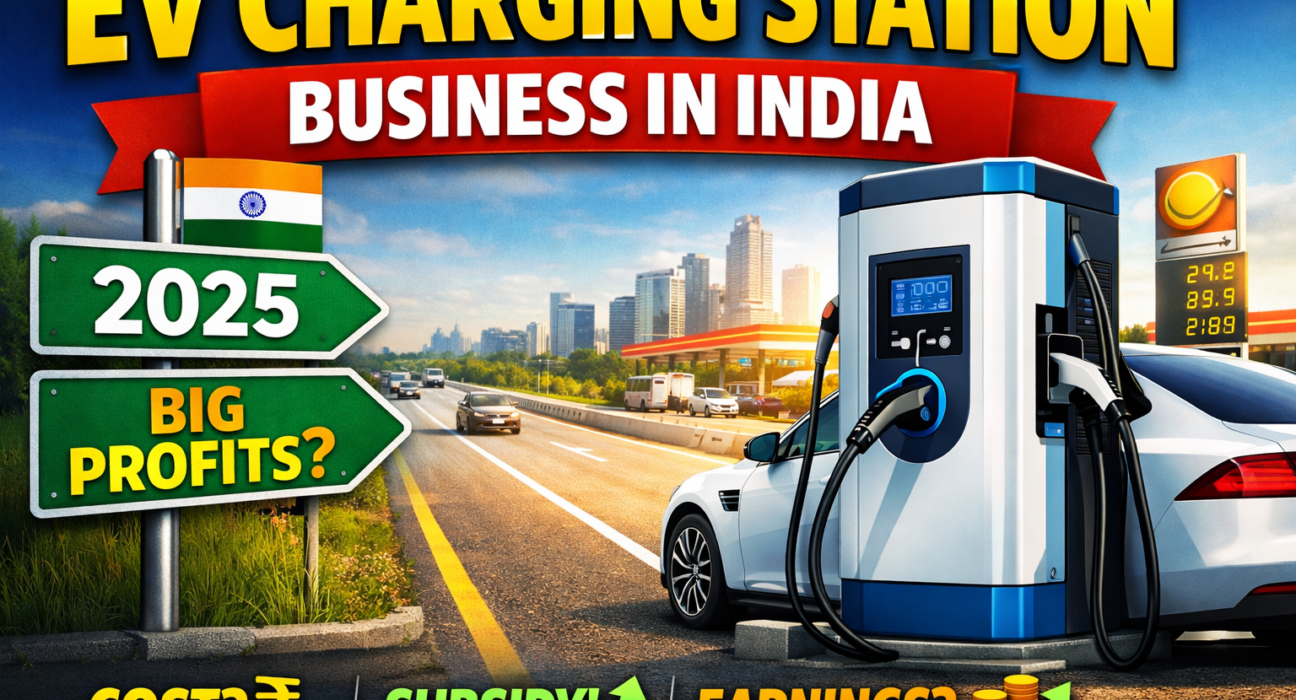
Electric vehicles are finally becoming practical in India — not because of marketing, but because charging infrastructure is now being financially supported by the Government of India.
Until recently, EV charging stations were:
- Capital-heavy
- Low utilization
- Difficult to monetize
That equation has started changing in 2024–2025, driven by:
- Clear national policy
- Capital support for chargers
- Rapid EV growth in fleets, logistics, and commercial use
This article explains why people are entering the EV charging station business now, how much it actually costs, how money is earned, and what to realistically expect — without exaggeration.
Why People Are Starting EV Charging Station Businesses Now
1. EV growth is finally visible on roads
Electric 2-wheelers, 3-wheelers, cars, electric mini-trucks, buses, and delivery fleets are increasing year-on-year. Charging demand is no longer theoretical — it is daily operational demand.
Public charging + fleet charging are both required.
2. Government support is now structured
The Government of India launched PM E-DRIVE Scheme (effective Oct 2024 – Mar 2026), which includes dedicated budget allocation for public EV charging infrastructure.
Key reality:
- Charging stations are not a licensed business
- Any individual, company, or landowner can set them up
- Capital support is routed via approved channels, states, PSUs, and partners
This has reduced entry risk significantly.
3. Charging is becoming a utility business
EV charging is slowly turning into:
- A power + service business
- Predictable demand (especially fleet & depot charging)
- Location-based income (similar to fuel pumps or telecom towers)
Smart operators are treating charging stations as long-term infrastructure assets, not quick-profit startups.
Types of EV Charging Station Business Models in India
1. Public charging station (city / highway)
- DC fast chargers (30–120 kW)
- Higher investment
- Depends on traffic and location
- Best near highways, malls, fuel pumps
2. Fleet / depot charging (most stable)
- AC chargers + limited DC
- Fixed monthly usage
- Used by logistics companies, factories, warehouses
- Predictable revenue, lower risk
3. Semi-public / commercial property charging
- Offices, hotels, housing societies
- Revenue sharing with property owner
- Lower capex per charger
Actual Cost Breakdown to Start an EV Charging Station (India)
Below is a realistic 2025 cost range, excluding exaggeration.
A. Small AC Charging Setup (Fleet / Commercial Use)
Configuration
- 5 to 10 AC chargers (7.4 kW or 11 kW)
Cost Breakdown
| Component | Approx Cost (₹) |
|---|---|
| AC chargers (5–10 units) | 4 – 8 lakh |
| Electrical panels & cabling | 1.5 – 3 lakh |
| Transformer / load upgrade (if required) | 2 – 5 lakh |
| Civil work & installation | 1 – 2 lakh |
| Software, metering, backend | 0.5 – 1 lakh |
Total Investment:
👉 ₹9 lakh to ₹18 lakh
Best for:
Factories, EV mini-truck fleets, warehouses, delivery hubs
B. DC Fast Charging Station (Public Use)
Configuration
- 1 × 60 kW or 120 kW DC fast charger
Cost Breakdown
| Component | Approx Cost (₹) |
|---|---|
| DC fast charger | 12 – 30 lakh |
| Transformer & HT connection | 6 – 12 lakh |
| Civil, foundation, safety | 2 – 4 lakh |
| Software, networking | 1 – 2 lakh |
| Approvals & commissioning | 1 – 2 lakh |
Total Investment:
👉 ₹22 lakh to ₹50+ lakh
Best for:
Highways, fuel pumps, malls, urban hubs
How EV Charging Stations Earn Money (Reality)
Revenue Sources
- Per-unit charging (₹12–₹25 per kWh depending on location)
- Fleet contracts (fixed monthly billing)
- Idle / parking fees
- Advertising & branding (future scope)
Example (Fleet Charging – Conservative)
- 10 vehicles
- Avg 25 kWh per vehicle per day
- Total = 250 kWh/day
- Billing @ ₹14/kWh
Monthly Revenue:
₹1.05–1.1 lakh
Electricity + O&M cost may consume ~60–65%.
This makes fleet charging more predictable than public-only charging.
Key Risks (Often Ignored)
- Poor location = low utilization
- Over-investing in DC chargers without demand
- High electricity tariff without load planning
- No fleet tie-ups
- Poor maintenance & uptime
Charging is not “install and forget”. It is an operations-driven business.
Frequently Asked Questions (FAQs)
Is EV charging station business legal in India?
Yes. EV charging is classified as an unlicensed activity. Anyone can set it up while following DISCOM and safety rules.
Do I need government approval?
No special central license.
You need:
- Power connection approval
- Electrical safety compliance
- Local civil permissions (if applicable)
Is subsidy guaranteed?
Subsidy is scheme-based, location-based, and routed through approved mechanisms. It is not automatic cash-back. Planning correctly is important.
What is the safest model for beginners?
Fleet / depot charging with signed usage commitments.
How long does it take to break even?
- Fleet charging: ~2–4 years
- Public DC stations: depends heavily on utilization and location
Which Companies Should You Consider Partnering With?
Choosing the right charger and backend partner matters more than brand hype.
In upcoming articles, we will deep-dive into charger OEMs, pricing, warranty, service support, and suitability.
Some major players active in India include:
👉 We’ll cover:
- Which charger is best for fleet vs public
- Real charger prices
- Service & AMC reality
- Which brands suit Indian grid conditions
Final Thought
EV charging stations are not a shortcut business, but they are becoming necessary infrastructure.
Those who:
- choose the right model
- control costs
- secure demand
will build long-term, utility-style income assets.
🔔 Stay connected
Next article:
👉 “Best EV Charger Companies in India (2025): Price, Warranty, Service & Reality Check”
If you want, I can now:
- Optimize this article for Google Featured Snippets
- Create internal linking strategy for EVTruckIndia
- Write the next charger company comparison article
- Create a LinkedIn authority post from this article
Just tell me what’s next.

Tata Power EZ Charge: Cost, Setup Process, Subsidy, Documents & Ground Reality - EV Truck India
December 22, 2025[…] EV Charging Station Business in India: Why 2025… […]