

Charging Infra Expansion Targets Last-Mile EV Scale-Up
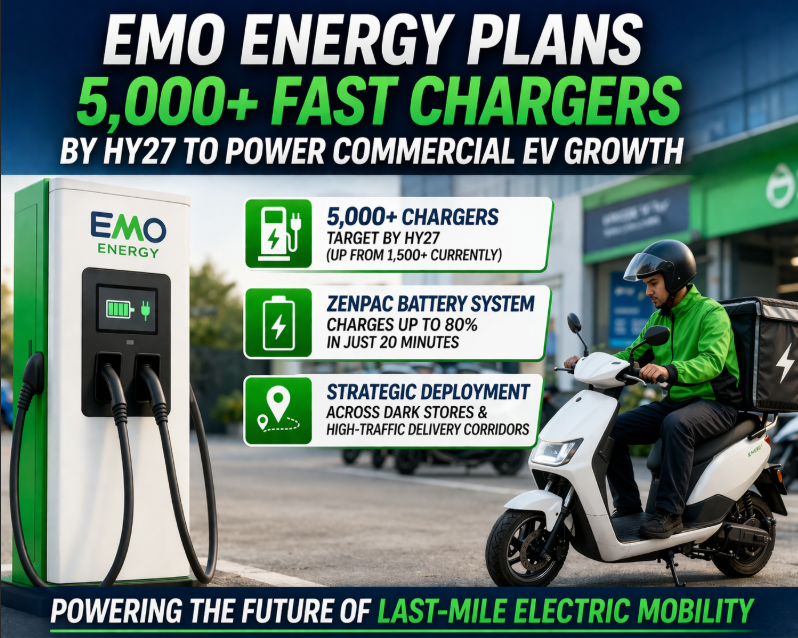
India’s commercial EV ecosystem is set for a major boost as EMO Energy announces plans to significantly expand its fast-charging network. The company aims to deploy over 5,000 chargers by the first half of 2027, a sharp increase from its current base of around 1,500 chargers.
This move signals a clear push toward solving one of the biggest bottlenecks in EV adoption — reliable a8/9d fast charging infrastructure for commercial fleets.
What EMO Energy is Planning
EMO Energy’s expansion strategy is focused on scaling fast-charging infrastructure specifically for commercial electric two-wheelers and last-mile delivery fleets.
Key Highlights:
- Target: 5,000+ chargers by HY27
- Current network: 1,500+ chargers
- Focus: Commercial EV ecosystem
The expansion is aligned with the growing demand from logistics companies, e-commerce players, and delivery aggregators that rely heavily on electric two-wheelers.
ZenPac Battery System: Fast Charging Advantage
A major differentiator in EMO Energy’s offering is its ZenPac battery system, designed for high-efficiency operations.
Key Capability:
- Up to 80% charge in just 20 minutes
This significantly reduces downtime for delivery fleets, enabling:
- Faster turnaround times
- Higher vehicle utilization
- Improved fleet productivity
For last-mile logistics, where time directly impacts revenue, such fast-charging capability can be a game changer.
Deployment Strategy: Where Chargers Will Be Installed
EMO Energy is not just expanding blindly — its deployment strategy is highly targeted.
Focus Areas:
- Dark stores (quick commerce hubs)
- High-density delivery corridors
- Urban logistics hotspots
This approach ensures that chargers are placed where demand is highest, particularly in areas with:
- High delivery volumes
- Frequent vehicle movement
- Fleet aggregation points
India Context: Why This Matters Now
India’s last-mile delivery ecosystem is growing rapidly, driven by:
- E-commerce expansion
- Quick commerce (10–20 minute delivery models)
- Increasing urban consumption
Electric two-wheelers are becoming the backbone of this segment due to:
- Low running cost
- Easy maneuverability
- Suitability for short-distance operations
However, charging infrastructure has remained a key constraint. EMO Energy’s expansion directly addresses this gap.
Company Background
Founded in 2022 by Sheetanshu Tyagi and Rahul Patel, EMO Energy operates at the intersection of:
- Battery technology
- Charging infrastructure
- Energy storage solutions
The company is positioning itself as a specialized infrastructure player for commercial EV operations, rather than a generic charging provider.
Market Impact: What This Means for Logistics & EV Adoption
1. Reduced Range Anxiety for Fleet Operators
With more fast chargers available in key locations, fleet operators can confidently expand EV usage.
2. Higher Fleet Efficiency
Fast charging reduces idle time, allowing vehicles to complete more delivery cycles per day.
3. Acceleration of EV Adoption
Improved infrastructure will encourage:
- Logistics companies
- Delivery startups
- Fleet aggregators
to shift faster toward electric mobility.
Strategic Insight
Unlike traditional public charging networks, EMO Energy’s focused approach on commercial use cases gives it a strong advantage.
By targeting:
- High-utilization zones
- Fleet-heavy corridors
- Delivery ecosystems
the company is aligning infrastructure with actual demand, not just visibility.
Conclusion: Infrastructure is the Real Enabler
India’s EV transition will not be driven by vehicles alone — it will depend heavily on charging infrastructure scalability.
EMO Energy’s plan to deploy 5,000+ fast chargers by 2027 is a clear step toward building that backbone for commercial EV adoption.
If executed effectively, this expansion could play a crucial role in:
- Scaling last-mile EV fleets
- Improving logistics efficiency
- Accelerating India’s shift toward electric mobility