

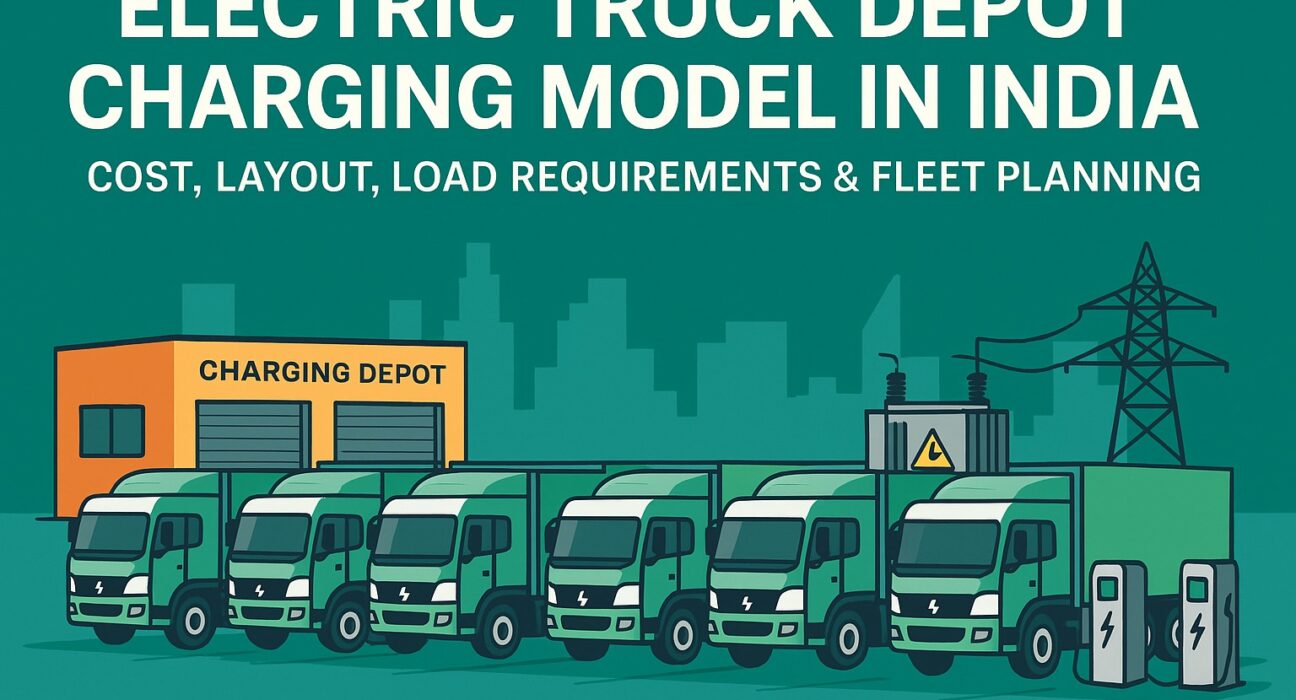
India’s logistics, FMCG, e-commerce, ports, airports, factories, and fleet operators are rapidly shifting toward electric trucks. But the biggest challenge they face is not the truck — it is how to charge 50, 100, or even 200 electric trucks daily inside a depot.
This guide explains the complete electric truck depot charging model in India (2025) including:
- Infrastructure layout
- Power load calculation
- Charging types
- Transformer & substation planning
- CAPEX cost
- OPEX running cost
- Government approvals
- Fleet planning best practices
This article is specially written for:
- Fleet owners
- Logistics companies
- Warehouse operators
- EV charging infrastructure firms
- Electric truck manufacturers
- Industrial park developers
Table of Contents
-
What Is an Electric Truck Depot Charging Model?
-
Why India Needs Dedicated EV Truck Depots (2025–2030)
-
Electric Truck Depot Charging Layout (Standard Design)
-
Types of Chargers Used in Electric Truck Depots
-
Electric Truck Power Load Requirement Calculation
-
Transformer & Electrical Infrastructure Planning
-
EV Truck Depot Setup Cost in India (2026)
-
Monthly Electricity Operating Cost
-
Battery Swapping vs Plug-in Charging at Depots
-
Fire Safety & Compliance Requirements
-
Smart Fleet Charging & Load Optimization
-
Government Subsidies & Policy Support (India 2026)
-
Fleet Planning Strategy for EV Truck Depots
-
Who Should Build EV Truck Depots in India?
-
Best Locations to Open an Electric Truck Depot in India
-
Future of Electric Truck Depots in India
-
FAQs – Electric Truck Depot Charging in India
-
Final Thoughts
What Is an Electric Truck Depot Charging Model?
An Electric Truck Depot Charging Model is a centralized charging infrastructure designed to charge multiple commercial electric trucks at a single location on a daily operational cycle.
Unlike public EV chargers, a depot model is private, high-load, continuous-use infrastructure built for:
- Logistics hubs
- Distribution centers
- Industrial warehouses
- Cold storage fleets
- Port & mining fleets
- Municipal corporations
The objective is simple:
✅ Keep every electric truck charged, routed, and revenue-generating without downtime.
Why India Needs Dedicated EV Truck Depots (2025–2030)
India’s commercial EV adoption is accelerating due to:
- Rising diesel prices
- GST benefits on EVs
- Government EV mandates
- Corporate ESG compliance
- Zero-emission logistics targets
- Lower maintenance of EV trucks
Large fleets cannot depend on roadside public chargers. They require:
- High-speed DC charging
- Load balancing
- 24/7 operational uptime
- Fleet scheduling integration
This makes EV truck depots inevitable infrastructure for India’s next decade of logistics.
Electric Truck Depot Charging Layout (Standard Design)
A well-designed EV truck depot includes:
✅ Core Zones
- Truck Parking Yard
- Charging Lane Section
- Transformer & Substation Area
- Power Distribution Room
- Charging Control Room
- Battery Service & Cooling Area
- Fire Safety & Emergency Zone
✅ Movement Flow
- Entry gate → Weigh bridge → Parking → Charging → Dispatch → Exit gate
✅ Space Requirement
| Fleet Size | Approx Land Needed |
|---|---|
| 10–20 trucks | 0.5–1 acre |
| 25–50 trucks | 1–2 acres |
| 100+ trucks | 3–5 acres |
Types of Chargers Used in Electric Truck Depots
🔹 1. AC Slow Chargers (7–22 kW)
- For overnight charging
- Used for light-duty trucks
- Low cost, long charging time
🔹 2. DC Fast Chargers (30–120 kW)
- Used for daily operational fleets
- Charging time: 1–3 hours
🔹 3. Ultra-Fast DC Chargers (150–350 kW)
- For ports, mining, highway fleets
- Expensive but ultra-high utilization
✅ Most Indian EV truck depots use 60 kW–120 kW DC chargers.
Electric Truck Power Load Requirement Calculation
Let’s understand load requirements with a practical example.
✅ Example: 50 Electric Trucks
- Battery size per truck: 30 kWh
- Daily charging: 1 full cycle
- Total daily energy = 50 × 30 = 1500 kWh/day
If charging is completed within 8 hours:
Required Load = 1500 ÷ 8 = 187.5 kW
Add:
- Cooling losses
- Future expansion
- Safety margin
✅ Final sanctioned load needed = 250–300 kW
Transformer & Electrical Infrastructure Planning
| Fleet Size | Transformer Capacity |
|---|---|
| Up to 20 Trucks | 250 kVA |
| 30–50 Trucks | 500–750 kVA |
| 100+ Trucks | 1–2 MVA |
Other required electrical systems:
- LT & HT panels
- Power factor correction
- Load management system
- Smart meters
- Backup power systems
- Surge protection
- Harmonic filters
EV Truck Depot Setup Cost in India (2025)
✅ Charging Equipment Cost
| Charger Type | Price Per Unit |
|---|---|
| 30 kW DC | ₹4–6 lakh |
| 60 kW DC | ₹8–12 lakh |
| 120 kW DC | ₹18–25 lakh |
✅ Electrical Infrastructure Cost
- Transformer & Substation: ₹15–40 lakh
- Cabling, panels, earthing: ₹8–20 lakh
- Software & load management: ₹3–10 lakh
✅ Total Estimated Cost
| Fleet Size | Approx Total Investment |
|---|---|
| 10 Trucks | ₹35–60 lakh |
| 25 Trucks | ₹80 lakh – ₹1.3 crore |
| 50 Trucks | ₹1.5–2.5 crore |
| 100 Trucks | ₹3–5 crore |
Monthly Electricity Operating Cost
Average commercial tariff in India (2025):
₹6–₹9 per unit (kWh)
✅ Example: 50 Trucks
- Daily consumption: 1500 units
- Monthly consumption: 45,000 units
- Monthly bill: ₹2.7–₹4 lakh
✅ Still 50–60% cheaper than diesel fuel cost.
Battery Swapping vs Plug-in Charging at Depots
| Parameter | Plug-in Charging | Battery Swapping |
|---|---|---|
| Infrastructure Cost | Medium | Very High |
| Downtime | 1–3 hours | 10–20 minutes |
| Battery Ownership | Fleet-owned | Operator-owned |
| Practical in India | ✅ Yes | ⚠️ Limited |
✅ Most Indian fleets prefer plug-in DC charging due to lower complexity and better control.
Fire Safety & Compliance Requirements
Mandatory safety infrastructure:
- Fire detection system
- CO2 / foam fire suppression
- Thermal runaway isolation area
- Emergency power shutoff
- Dedicated fire water tank
- Explosion-proof electrical fittings
- EV-rated fire extinguishers
Compliance authorities:
- DISCOM
- Electrical Inspector
- Fire Department
- Local Municipality
- State Pollution Control Board
Smart Fleet Charging & Load Optimization
Modern depots use:
- AI-based load scheduling
- Time-of-day tariff optimization
- Vehicle-to-grid readiness
- Remote charger monitoring
- Predictive maintenance alerts
Benefits:
- Lower electricity bills
- No overload tripping
- Longer battery life
- Zero queue delays
Government Subsidies & Policy Support (India 2025)
- State EV policies offer:
- Capital subsidy on chargers
- Electricity tariff discounts
- Land rebates
- Grid connection fast-tracking
- FAME incentives still apply to vehicles
- GST on EV chargers is 5%
✅ Some states offer up to 25–40% capex subsidy on charging stations.
Fleet Planning Strategy for EV Truck Depots
Key planning factors:
- Route distance mapping
- Return-to-base timing
- Truck idle periods
- Battery degradation
- Charger-to-truck ratio (Ideal: 1:3)
- Maintenance scheduling
- Driver shift synchronization
Who Should Build EV Truck Depots in India?
- Large logistics companies
- 3PL operators
- E-commerce delivery firms
- Industrial clusters
- Port authorities
- Municipal waste operators
- Mining contractors
- Cold chain logistics
Best Locations to Open an Electric Truck Depot in India (Strategic Site Selection)
Choosing the right location for an Electric Truck Depot is as important as selecting the chargers and transformers. A wrong location can increase power cost, land cost, and route inefficiency — while a strategic location can reduce operating expenses by 20–30%.
✅ Ideal Locations to Open an EV Truck Charging Depot
You should open an electric truck depot in locations that have:
-
Logistics & Transport Hubs
-
City freight terminals
-
Transport Nagar areas
-
Truck terminals
-
ICD & CFS locations
-
Railway cargo yards
-
-
Industrial Clusters & Manufacturing Zones
-
Auto component zones
-
FMCG manufacturing belts
-
Textile & pharma clusters
-
Steel & heavy engineering parks
-
-
Warehousing & Distribution Corridors
-
E-commerce fulfillment centers
-
Cold storage hubs
-
3PL & 4PL distribution parks
-
-
Ports, Airports & SEZ Regions
-
Port container yards
-
Cargo terminals
-
Special Economic Zones
-
Coastal logistics parks
-
-
Urban Last-Mile Commercial Zones
-
Wholesale markets
-
Mandi areas
-
Retail distribution clusters
-
Municipal waste processing zones
-
✅ Top High-Potential EV Truck Depot Regions in India (2025–2030)
-
Delhi–NCR (Gurgaon, Ghaziabad, Faridabad, Sonipat)
-
Mumbai–Navi Mumbai–Pune logistics belt
-
Chennai–Sriperumbudur–Oragadam
-
Bengaluru–Tumkur Industrial Corridor
-
Ahmedabad–Sanand–Changodar
-
Hyderabad–Medchal–Shamshabad
-
Kolkata–Dankuni logistics hub
-
Surat–Bharuch industrial belt
-
Nagpur multimodal logistics hub
✅ Location Selection Checklist Before Buying Land
Before finalizing land, always verify:
-
Availability of high-tension electricity connection
-
Distance to main freight routes
-
DISCOM transformer approval feasibility
-
Fire department accessibility
-
Land-use zoning (industrial / commercial)
-
Flood-free elevation
-
Future expansion possibility
-
24×7 truck movement permissions
✅ Best Practice Tip
The most successful electric truck depots in India are being built within 5–8 km radius of major freight generators, not on highways far outside the city. This reduces dead kilometers, saves battery energy, and improves fleet uptime.
Future of Electric Truck Depots in India
By 2030, India will require:
- 20,000+ commercial EV depots
- Dedicated EV freight corridors
- Smart grid-integrated logistics hubs
Upcoming trends:
- Robotic charging
- Megawatt charging systems (MCS)
- Solar-powered depots
- Energy storage integration
- Green hydrogen hybrid charging
FAQs – Electric Truck Depot Charging in India
Q1. How many chargers are needed for 50 EV trucks?
Ideally 15–20 DC fast chargers using shift-based charging.
Q2. Can EV depots use solar power?
Yes, rooftop and ground-mounted solar significantly reduce operating costs.
Q3. What is the payback period of an EV truck depot?
Typically 2.5–4 years depending on fleet utilization.
Q4. Is permission required for private EV charging depots?
Yes. Electrical inspectorate, DISCOM, and fire NOC are mandatory.
Final Thoughts
An Electric Truck Depot Charging Model is no longer a future concept — it is becoming mission-critical infrastructure for India’s commercial EV revolution.
Fleet operators who plan depots correctly today will:
✅ Save crores in fuel costs
✅ Achieve ESG compliance
✅ Reduce downtime
✅ Scale faster than diesel-based competitors