

As electric trucks scale rapidly across India’s logistics, mining, municipal, and fleet sectors, one critical issue is moving to the forefront: what happens to EV batteries after their useful life ends?
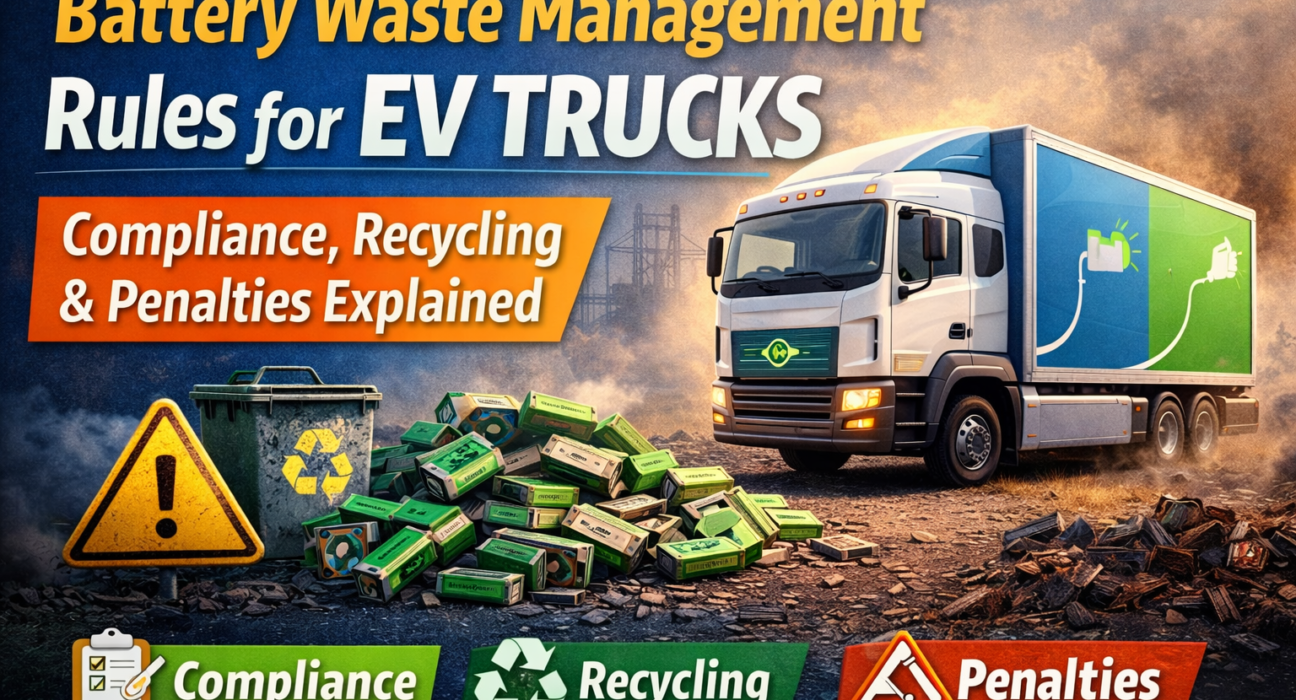
To address environmental risks and enforce accountability, the Government of India has introduced the Battery Waste Management Rules (BWMR) under the Environment (Protection) Act, replacing the earlier e-waste framework for batteries.
This article explains how EV truck battery waste must be handled, who is responsible for compliance, how recycling works, and what penalties apply if rules are violated.
1. Why Battery Waste Management Matters for EV Trucks
EV truck batteries are large-format lithium-ion or advanced chemistry packs containing:
• Lithium
• Cobalt
• Nickel
• Manganese
• Graphite
• Electrolytes
Improper disposal can cause:
❌ Soil and water contamination
❌ Fire and explosion hazards
❌ Loss of critical minerals
❌ Regulatory violations for fleet operators and OEMs
With the growing volume of commercial EVs, the government now treats battery waste as a regulated industrial category.
2. What Are the Battery Waste Management Rules (BWMR)?
The Battery Waste Management Rules, 2022 (amended and enforced through 2024–2026) govern the entire lifecycle of batteries, including:
• Manufacturing
• Import
• Use
• Collection
• Recycling
• Disposal
These rules apply to:
✔ Lithium-ion batteries
✔ Lead-acid batteries
✔ Sodium-ion and future chemistries
✔ EV traction batteries used in trucks, buses, and fleets
Core Objective:
To ensure environmentally safe disposal and enforce Extended Producer Responsibility (EPR).
3. Who Must Comply? (EV Truck Ecosystem)
Under BWMR, the following stakeholders are legally responsible:
3.1 EV Truck Manufacturers (OEMs)
Tata Motors, Ashok Leyland, Eicher, Mahindra, Switch, OSM, Euler, etc.
✔ Must ensure collection and recycling of batteries they place in the market
✔ Must meet annual recycling targets under EPR
✔ Must register on the government EPR portal
3.2 Battery Manufacturers & Importers
✔ Responsible for environmentally safe processing
✔ Must source from authorized recyclers only
3.3 Fleet Operators & Truck Owners
✔ Cannot discard batteries as scrap or municipal waste
✔ Must return used batteries to authorized collection centers
✔ Must maintain records of disposal and replacement
3.4 Recyclers & Refurbishers
✔ Must be CPCB/SPCB authorized
✔ Must meet material recovery efficiency targets
✔ Must upload compliance data to the EPR system
4. Extended Producer Responsibility (EPR) Explained
EPR = Legal obligation of producers to collect, recycle, or refurbish used batteries.
For EV trucks, this means:
• OEMs must ensure batteries sold with vehicles are eventually collected
• Targets are assigned in percentage of batteries introduced into the market
• Non-compliance results in financial penalties
EPR Targets (Indicative)
| Year | Collection / Recycling Obligation |
|---|---|
| 2024–25 | Minimum recovery percentage mandated |
| 2025–26 | Higher recycling efficiency target |
| 2026 onwards | Full lifecycle traceability via digital records |
(Exact percentages are notified by CPCB under evolving compliance frameworks.)
5. How EV Truck Battery Recycling Works
Step 1: Collection
• Fleet operator or OEM retrieves end-of-life battery
• Battery transferred only to authorized collection centers
Step 2: Dismantling
• Battery packs are safely discharged
• Modules and cells are separated
Step 3: Material Recovery
Recyclers extract:
✔ Lithium
✔ Cobalt
✔ Nickel
✔ Copper
✔ Aluminum
✔ Graphite
Using hydrometallurgical or mechanical processes.
Step 4: Reuse / Second Life
• Some EV truck batteries are repurposed for:
– Stationary energy storage
– Solar backup systems
– Telecom and industrial power
Step 5: Final Disposal
• Non-recoverable waste is disposed through certified hazardous waste channels.
6. Compliance Checklist for EV Truck Owners & Fleet Operators
If you operate EV trucks in India, you must ensure:
✔ Battery is replaced only through authorized service channels
✔ Old battery is handed over to OEM / authorized recycler
✔ Proof of recycling or return is maintained
✔ No resale of used batteries to informal scrap dealers
✔ Compliance records kept for audits
Failure to follow this may result in penalties under environmental law.
7. Penalties for Non-Compliance
Violations under Battery Waste Management Rules can attract:
7.1 Financial Penalties
• Monetary fines based on:
– Volume of battery waste mishandled
– Duration of non-compliance
– Environmental impact
7.2 Environmental Compensation
• Polluters may be required to pay environmental damage charges
• CPCB/SPCB may impose per-ton penalties for illegal disposal
7.3 Operational Restrictions
• Suspension or cancellation of:
– Manufacturing licenses
– Recycling authorization
– Import/export permissions
7.4 Legal Action
• Cases may be filed under:
– Environment (Protection) Act
– Hazardous waste regulations
8. Role of CPCB & State Pollution Control Boards (SPCBs)
The compliance framework is monitored by:
✔ Central Pollution Control Board (CPCB)
✔ State Pollution Control Boards (SPCBs)
Their responsibilities include:
• Authorizing recyclers
• Auditing EPR targets
• Tracking battery movement via digital portals
• Enforcing penalties
9. How This Impacts the EV Truck Industry
For OEMs
✔ Mandatory recycling partnerships
✔ Increased cost but better ESG compliance
For Fleet Operators
✔ Legal responsibility for battery disposal
✔ Structured replacement programs
✔ Reduced fire and safety risks
For Recyclers
✔ New business opportunities
✔ Demand for advanced recycling technologies
For Environment
✔ Reduced landfill dumping
✔ Circular economy for critical minerals
✔ Lower import dependency
10. Official Reference & Policy Links
You may include outbound links to improve authority:
• Ministry of Environment, Forest and Climate Change (MoEFCC)
https://moef.gov.in
• Central Pollution Control Board (CPCB)
https://cpcb.nic.in
• Battery Waste Management Rules Notifications
https://egazette.nic.in
• Environment (Protection) Act
https://legislative.gov.in
11. FAQs: Battery Waste Management for EV Trucks
Q1. Are EV truck batteries covered under Battery Waste Management Rules?
Yes. All lithium-ion and advanced chemistry batteries used in commercial EVs are fully covered.
Q2. Can fleet operators sell old EV batteries to scrap dealers?
No. Batteries must be returned to OEMs or authorized recyclers only.
Q3. Who is responsible for recycling—OEM or truck owner?
Primary responsibility lies with the producer (OEM/battery supplier) under EPR, but owners must ensure batteries are returned through proper channels.
Q4. What happens if battery waste is disposed illegally?
Penalties may include fines, environmental compensation, and legal action under the Environment Protection Act.
Q5. Can EV truck batteries be reused?
Yes. Many batteries are repurposed for stationary storage or backup power before final recycling.
12. Conclusion
India’s Battery Waste Management Rules are reshaping how EV truck batteries are handled—from manufacturing to end-of-life recycling. For OEMs, fleet operators, and charging ecosystem players, compliance is no longer optional—it is a legal and environmental responsibility.
Proper recycling, documented disposal, and EPR compliance will not only avoid penalties but also strengthen sustainability, ESG credibility, and long-term operational safety.