

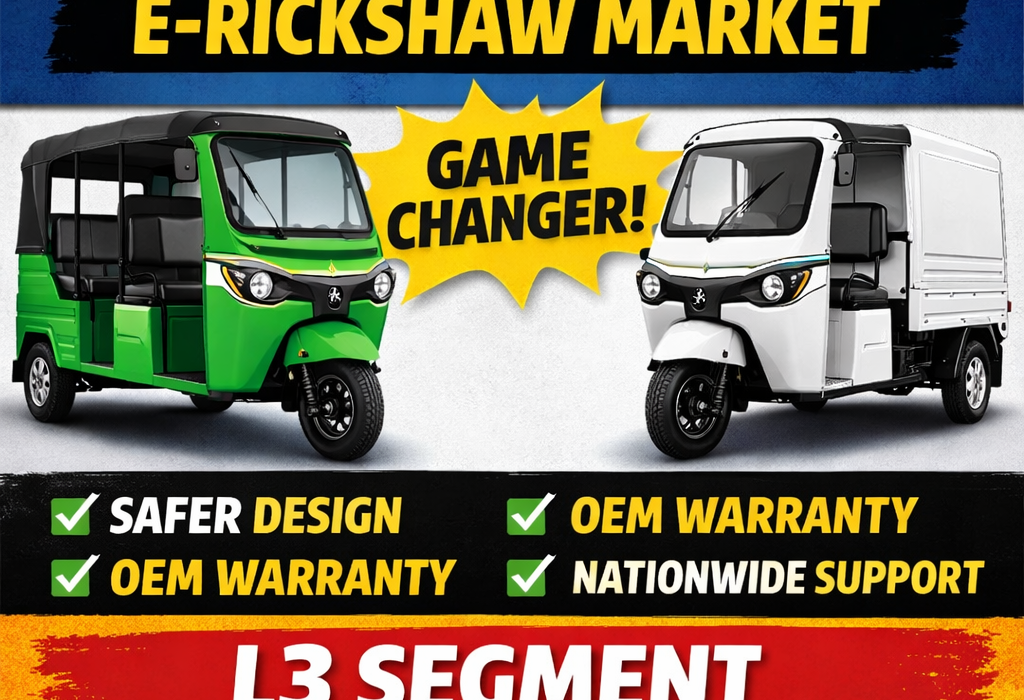
The Indian L3 electric e-rickshaw market has long been volume-driven but highly fragmented—dominated by small, often unorganised manufacturers with inconsistent quality, weak warranties, and limited after-sales support.
That status quo is now facing disruption with Bajaj Auto Ltd. officially entering the electric e-rickshaw space through its new brand Bajaj Riki.
This move is significant not just because a large OEM has entered the segment, but because Bajaj is introducing automotive-grade engineering, structured warranties, and nationwide dealer-backed service—elements largely missing in the L3 category until now.
1. Bajaj Riki: Strategic Expansion into Mass Electric Mobility
Bajaj Auto’s electric journey began with scooters like Chetak. With Bajaj Riki, the company is now targeting high-volume, income-generating mobility, directly addressing:
- Urban passenger transport
- Semi-urban and rural connectivity
- Last-mile cargo movement
The Riki platform is developed to meet AIS-048 L3 norms, ensuring compliance, durability, and safety standards suitable for commercial operations.
2. Bajaj Riki P4005 (Passenger E-Rickshaw) – Full Specifications
🔹 Key Highlights
- Model: Bajaj Riki P4005 (Passenger)
- Platform: P40 series
- Ex-showroom price: ₹1,90,890
- Seating capacity: Driver + 4 passengers
- Target use: Urban & semi-urban passenger transport
🔹 Battery & Range
- Battery capacity: 5.4 kWh
- Battery type: Lithium-ion (automotive-grade cells)
- Certified range: Up to 149 km (IDC cycle)
- Real-world range: ~100–120 km (load, terrain dependent)
🔹 Charging
- Charging time: ~4.5 hours (standard AC charger)
- Charging type: 15A single-phase AC
- Onboard charger: Factory-fitted
- Home / shop charging compatible: Yes
🔹 Build, Safety & Chassis
- Chassis type: Monocoque architecture (rare in L3 segment)
- Braking: Hydraulic brakes (front & rear)
- Suspension: Tuned for passenger comfort on poor roads
- Structural benefit: Better rollover resistance vs tube-frame e-rickshaws
🔹 Warranty
- Battery warranty: 3 years
- Vehicle warranty: OEM-backed (dealer-supported)
3. Bajaj Riki C4005 (Cargo E-Rickshaw) – Designed for Goods Movement
Recognising the growth of last-mile logistics, Bajaj has also introduced a dedicated cargo variant.
🔹 Key Highlights
- Model: Bajaj Riki C4005 (Cargo)
- Ex-showroom price: ₹2,00,876
- Certified range: Up to 164 km
- Gradeability: 28%
- Use case: E-commerce, kirana delivery, milk & agri transport
🔹 Cargo-Focused Engineering
- Reinforced load body
- Optimised torque delivery
- Better hill-start capability
- Stable rear axle for uneven loads
4. Comparison Table: Bajaj Riki vs Typical Unorganised L3 E-Rickshaws
| Parameter | Bajaj Riki P4005 | Typical Local L3 E-Rickshaw |
|---|---|---|
| Manufacturer | Large OEM (Bajaj Auto) | Unorganised / assembler |
| Chassis | Monocoque | Tube / welded frame |
| Battery | 5.4 kWh Li-ion | 4–5 kWh (varies) |
| Certified Range | 149 km | 90–120 km |
| Brakes | Hydraulic | Mechanical (mostly) |
| Warranty | 3 years battery | 6–12 months |
| Charging Safety | OEM-validated | Often untested |
| After-sales | Nationwide dealer network | Local mechanic |
| Financing | Bank / NBFC supported | Limited |
5. Subsidy & Registration: Is Bajaj Riki Eligible?
🔹 Central Subsidy (FAME-II)
- No direct FAME-II subsidy currently applicable to new L3 e-rickshaws (scheme winding down).
🔹 State-Level Benefits (Varies by State)
Depending on the state, buyers may receive:
- Road tax exemption
- Registration fee waiver
- Permit relaxation
- EV policy incentives
👉 Buyers should check their state transport department EV policy:
6. Cost of Ownership (TCO) – Why Bajaj Riki Changes the Equation
🔹 Daily Operating Economics
- Electricity cost per km: ₹0.6 – ₹0.8
- Diesel/ICE alternative: ₹3.5 – ₹4.5 per km
- Monthly savings (150 km/day): ₹12,000–₹15,000+
🔹 Maintenance Advantage
- No engine oil
- No clutch or gearbox
- Fewer moving parts
- Predictable service intervals
7. How to Buy Bajaj Riki (Step-by-Step)
- Locate authorised Bajaj Riki dealer
👉 https://www.bajajauto.com - Choose variant: Passenger (P4005) or Cargo (C4005)
- Arrange financing (Bajaj Finserv / partner banks)
- Submit documents:
- Aadhaar
- PAN
- Address proof
- Driving licence
- Vehicle registration (VAHAN)
- Delivery & training
8. Market Rollout Strategy: Where Bajaj Riki Is Available
🔹 Pilot Cities
- Patna
- Moradabad
- Guwahati
- Raipur
🔹 Phase-1 Expansion (100+ towns)
- Uttar Pradesh
- Bihar
- Madhya Pradesh
- Chhattisgarh
- Assam
This phased approach allows Bajaj to stabilise service quality before pan-India expansion.
9. Why Bajaj’s Entry Truly Matters for the L3 Segment
Bajaj Riki’s launch signals:
- Formalisation of the e-rickshaw market
- Shift from price-only buying to lifecycle value
- Pressure on unorganised players to improve quality
- Better safety outcomes for drivers and passengers
- Stronger confidence among banks & fleet operators
For the first time, L3 buyers can access OEM-grade engineering with predictable warranties, similar to higher vehicle categories.
FAQs – Bajaj Riki Electric E-Rickshaw
Q1. Is Bajaj Riki suitable for daily commercial use?
Yes. It is engineered specifically for high-utilisation passenger and cargo operations.
Q2. Can it be charged at home or shop?
Yes, standard 15A AC socket charging is supported.
Q3. What is the real-world range?
Expect ~100–120 km depending on load, driving style, and terrain.
Q4. Is financing available?
Yes, through Bajaj-backed finance partners and NBFCs.
Q5. Does monocoque chassis really matter?
Yes. It improves crash integrity, reduces flex, and enhances long-term durability.
Final Takeaway
Bajaj Auto’s entry into electric e-rickshaws is not incremental—it is transformational.
By introducing structured warranties, safer architecture, and nationwide support, Bajaj Riki sets a new benchmark that could permanently change how the L3 segment is built, sold, and trusted in India.