

India’s last-mile delivery ecosystem is undergoing a structural shift. Rising fuel costs, increasing demand for hyperlocal logistics, and platform-based gig work are pushing delivery riders and fleet operators toward electric mobility. In this transition, purpose-built electric cargo vehicles are gaining importance over converted scooters or retrofitted solutions.
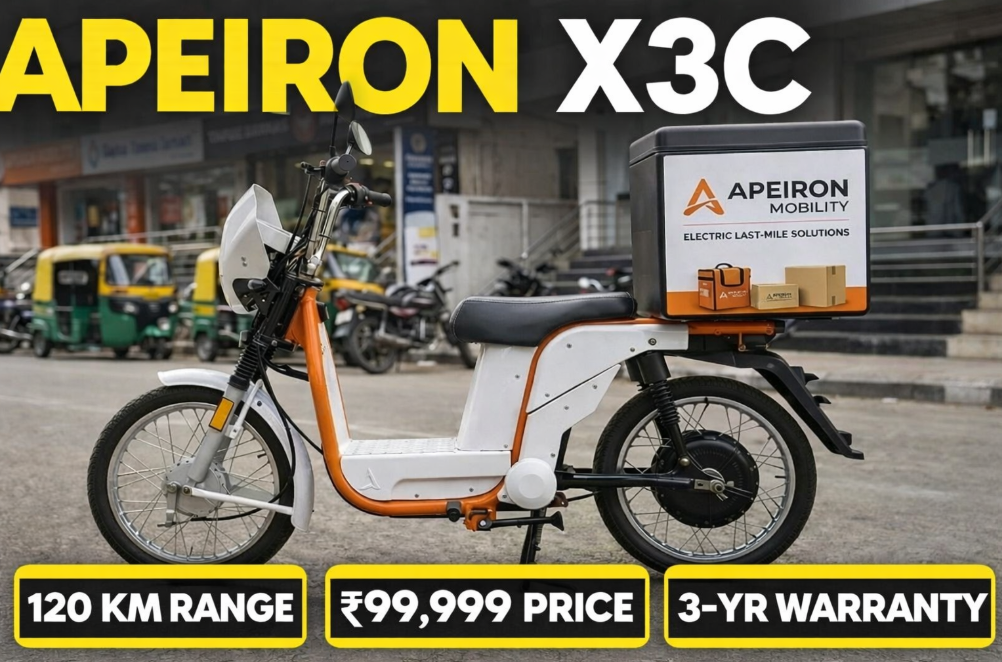
The Apeiron X3c electric cargo bike is one such product designed specifically for Indian delivery conditions. It is not positioned as a lifestyle EV, but as a work-focused, income-generating asset built for daily operations.
Apeiron X3c: Product Overview
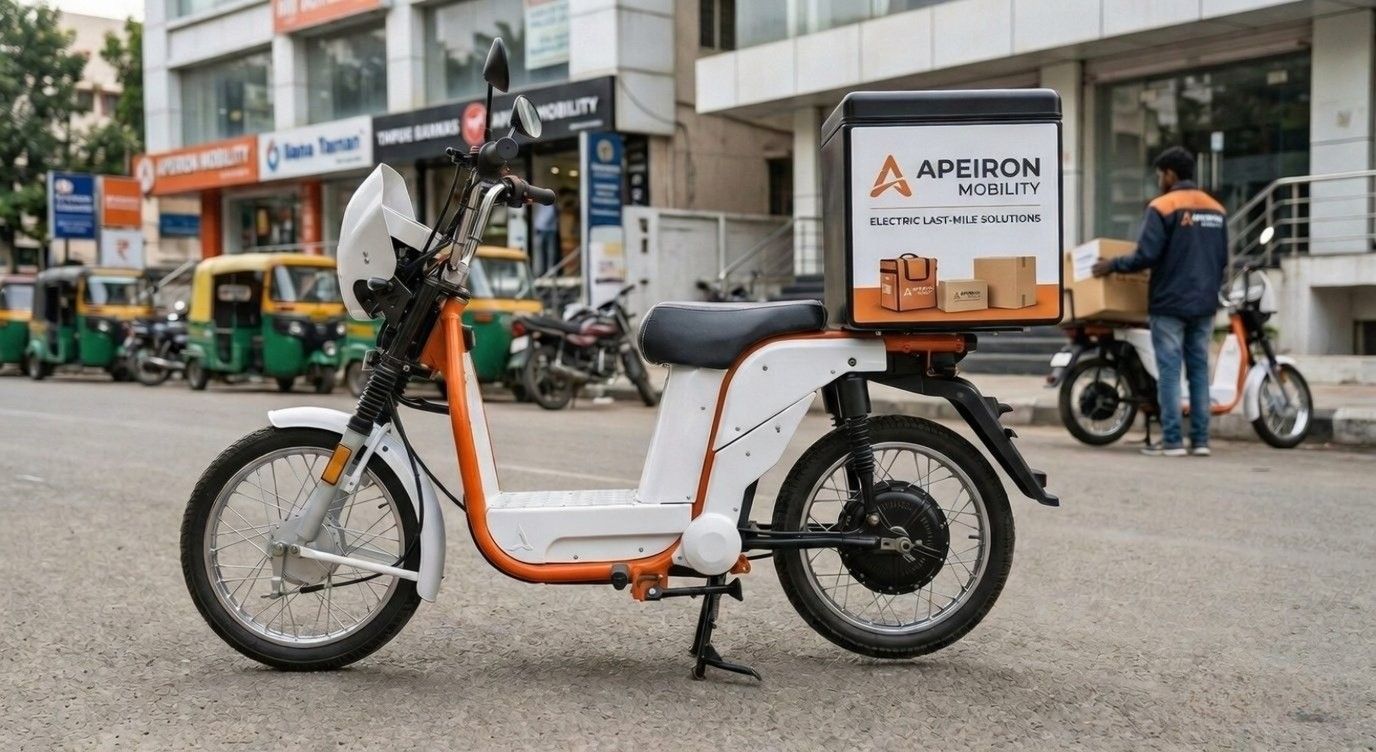
The Apeiron X3c is an ICAT-certified low-speed electric cargo vehicle (L1 category) developed in India and incubated at SINE, IIT Bombay. It is designed to cater to high-usage delivery environments such as food delivery, grocery logistics, and e-commerce parcel movement.
Key positioning:
- Built for daily earnings, not occasional use
- Focused on low operating cost and high uptime
- Designed for Indian roads and rider ergonomics
Design Philosophy: Utility Over Aesthetics
Unlike conventional electric scooters adapted for cargo use, the X3c is engineered from the ground up as a cargo carrier.
Key Design Elements
- Short Wheelbase
Enables maneuverability in narrow urban lanes, crowded markets, and apartment complexes. - High Ground Clearance
Critical for Indian speed breakers, waterlogged roads, and uneven construction patches. - 16-inch Wheels
Larger wheels improve ride stability, reduce shock transfer to cargo, and enhance durability. - Reinforced Frame Structure
Built to handle consistent payload stress across long working hours. - Ergonomic Riding Geometry
Upright seating posture reduces fatigue during long shifts (8–10 hours daily usage).
Performance & Range Analysis
Real-World Range
- Claimed Range: 120 km per charge
- Test Conditions: Urban traffic, inclines, stop-go riding (Bangalore conditions)
This is a critical differentiator because most EVs quote ideal lab conditions, whereas X3c focuses on real-world delivery cycles.
Speed & Category
- Top Speed: ~25 km/h
- Falls under L1 category, which means:
- No driving license required
- No registration complexity in many states
Charging Details
- Charging Time: 4–5 hours
- Charging Type: Standard plug (home-compatible)
This allows overnight charging and full-day operation without mid-shift downtime.
Battery, Powertrain & Durability
Battery
- Type: Lithium-ion
- Usage Life: Estimated 3–5 years (depending on charge cycles and usage pattern)
Powertrain Components
- Motor
- Controller
- Battery
These three components are the most expensive in any EV, and Apeiron offers full coverage on all of them.
Warranty & Service Ecosystem
3-Year Comprehensive Warranty
Covers:
- Battery
- Motor
- Controller
This is significant because:
- Most competitors offer limited or prorated battery warranties
- Unexpected failures in these components can cost 30–50% of vehicle value
24-Hour Service Commitment
- Guaranteed turnaround within 24 hours
- Local spare parts availability
- No dependency on imported components
This directly impacts vehicle uptime, which is crucial for delivery income.
Cargo Capability & Business Use Cases
Cargo Configurations
The X3c supports multiple carrier types:
- Insulated boxes (food delivery)
- Deep panniers (grocery and quick commerce)
- Flatbeds (parcel and logistics use)
Payload Capacity
- Estimated usable payload: 80–120 kg range
- Suitable for most last-mile delivery operations
Pricing Structure (India 2026)
Launch Pricing
- Ex-showroom (Karnataka): ₹99,999
- Standard Price: ₹1,09,999
Cost Positioning
This places the X3c:
- Below electric three-wheelers
- Slightly above standard electric scooters
- In a niche cargo-first EV segment
Subsidy & Policy Benefits
Karnataka Benefits
- 100% Road Tax Exemption
- Registration Fee Waiver
- Additional EV incentives (subject to policy updates)
Other States
While currently focused on Karnataka, similar benefits may apply in:
- Delhi
- Maharashtra
- Uttar Pradesh
Depending on local EV policies.
Ownership Economics
Rental vs Ownership Model
Rental Model (Current Market Reality)
- ₹7,500 to ₹12,000 per month
- No asset ownership
- Long-term cost burden
X3c Ownership Model
- Approx EMI: ₹3,500/month
- Asset ownership
- Lower long-term cost
Net Savings
- ₹4,000 to ₹8,500 per month
This makes the X3c a financial upgrade rather than just a vehicle purchase.
Running Cost Analysis
- Estimated cost per km: ₹0.15 to ₹0.25
- Petrol scooter comparison: ₹2–₹3 per km
Over 100 km daily usage:
- Petrol cost: ₹200–₹300/day
- EV cost: ₹15–₹25/day
This results in significant monthly savings.
How to Buy Apeiron X3c
Purchase Process
- Submit inquiry through official platform : Apeiron Mobility Pvt Ltd
- Connect with sales team
- Schedule test ride (Bangalore)
- Select cargo configuration
- Apply for financing (optional)
- Confirm booking
- Delivery and onboarding
Availability & Distribution
Current Market
- Primary availability: Bangalore / Karnataka
Expansion Outlook
- Expected to expand into major urban logistics hubs
- Dependent on service network scaling
Contact Details
- Company: Apeiron Mobility Pvt Ltd
- Address: ITI Ancillary Estate, Mahadevapura, Bangalore – 560048
- Email: contact@apeironmobility.com
Brochure Availability
- Official brochure available on request
- Can be accessed via:
- Website inquiry
- WhatsApp support : +91 76250 05930
Who Should Buy Apeiron X3c
Ideal Buyers
- Delivery partners working 8–12 hours daily
- Fleet operators managing urban logistics
- Small businesses with recurring delivery needs
- Quick commerce and hyperlocal logistics companies
Not Suitable For
- High-speed commuting
- Intercity transport
- Heavy cargo logistics beyond 120 kg
Advantages and Limitations
Advantages
- Low operating cost
- Strong warranty coverage
- Real-world range validation
- High uptime due to fast service
- No license requirement
Limitations
- Limited top speed (25 km/h)
- Geographic availability currently restricted
- Early-stage service network outside Karnataka
Competitive Positioning
Compared to traditional options:
| Segment | Comparison |
|---|---|
| Petrol scooters | Higher running cost |
| Rental EVs | No ownership benefit |
| Electric 3-wheelers | Higher cost, less maneuverability |
The X3c fits in a unique middle segment:
- Affordable
- Purpose-built
- Business-oriented
Frequently Asked Questions (FAQs)
What is Apeiron X3c?
An electric cargo bike designed for last-mile delivery and logistics.
What is the real-world range?
Up to 120 km per charge under urban conditions.
What is the charging time?
Approximately 4–5 hours.
Is a driving license required?
No, it is an L1 category vehicle.
What is the warranty coverage?
3 years on battery, motor, and controller.
Is financing available?
Yes, EMI options are available.
Can I test ride the vehicle?
Yes, currently available in Bangalore.
What is the cargo capacity?
Approximately 80–120 kg depending on usage.
Is it suitable for food delivery?
Yes, with insulated cargo configurations.
Where can I buy it?
Currently in Karnataka, with expansion expected.
Final Analysis: EV Truck India Perspective
The Apeiron X3c represents a shift from vehicle ownership to income optimization. Instead of being positioned as a mobility product, it is structured as a daily earning tool for delivery professionals.
Key strengths:
- Strong cost advantage over rental models
- High warranty confidence
- Real-world usability focus
Key risk factors:
- Limited geographic presence
- Dependence on service expansion
Conclusion
For delivery riders and small logistics operators, the Apeiron X3c offers a clear economic case. It reduces dependency on rental fleets, lowers operational costs, and provides asset ownership.
In the current EV ecosystem, products that directly improve earnings rather than just reduce emissions are more likely to scale. The Apeiron X3c fits that category.