

Ground Reality of Earnings, Expenses, and Profit in EV Logistics
Introduction: The Biggest Question – “Kitna Kama Sakte Hain?”
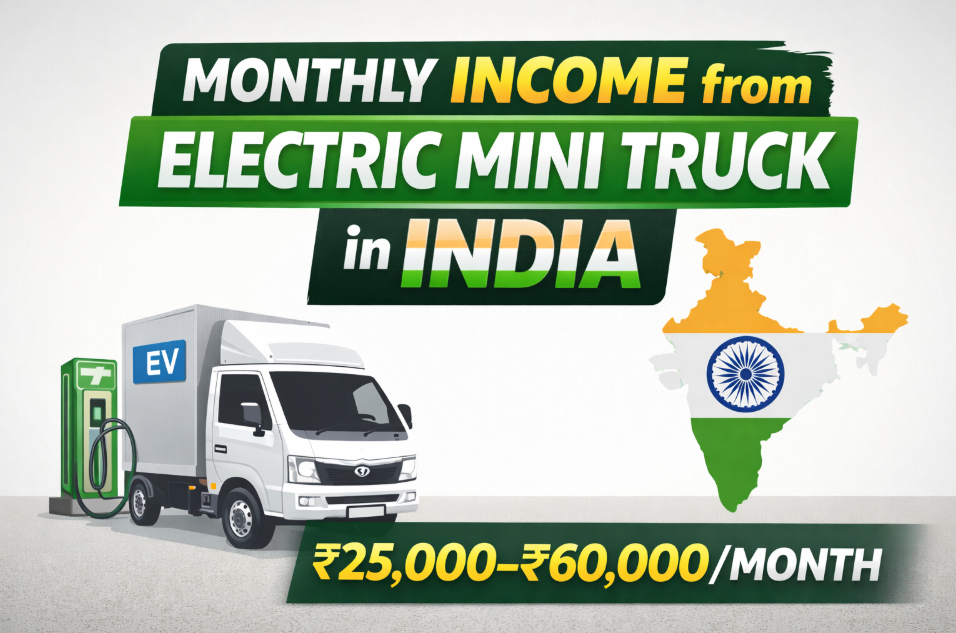
In India’s rapidly growing electric vehicle ecosystem, one question dominates every discussion around electric mini trucks: “Isme monthly income kitni hoti hai?”
From small business owners to first-time entrepreneurs, everyone is trying to understand whether switching to an electric mini truck is financially viable. With rising diesel prices and increasing demand for last-mile delivery, EV mini trucks are being projected as a high-profit opportunity.
However, the reality is more nuanced. Income depends on multiple factors—route, client type, daily running, electricity cost, and most importantly, how efficiently the vehicle is utilized.
This article breaks down the real monthly income calculation, not assumptions, so you can clearly understand whether this business is worth entering.
How to Start EV Truck Transport Business in India
Understanding the Business Model of Electric Mini Trucks
Electric mini trucks are primarily used for last-mile delivery and short-distance logistics, especially within cities. Their typical use cases include e-commerce deliveries, grocery supply, courier services, and warehouse distribution.
Unlike diesel trucks, which are often used for long-haul transport, EV mini trucks operate in fixed routes and predictable daily cycles. This makes their income more stable but also dependent on utilization.
Most operators work on one of these models:
- Per km billing (₹20–₹40/km)
- Per trip/delivery basis
- Fixed monthly contract (most profitable)
In reality, contract-based work generates the most consistent income, especially when tied with companies like e-commerce or FMCG distributors.
Real Monthly Income Calculation (Example Case)
Let’s break this down with a practical example.
Assumptions:
- Daily running: 80 km
- Working days: 26 days/month
- Rate per km: ₹25
Monthly Revenue Calculation:
80 km × ₹25 = ₹2,000 per day
₹2,000 × 26 days = ₹52,000 monthly revenue
👉 This is a realistic baseline for a single EV mini truck in city operations.
Expense Breakdown (Realistic Numbers)
Now let’s subtract expenses to understand actual profit.
1. Electricity Cost
- Cost per km: ₹1–₹1.5
- Monthly cost: ₹3,000–₹4,000
Electricity is the biggest advantage of EVs—it is significantly cheaper than diesel.
2. Driver Salary
- ₹10,000 – ₹15,000/month
If you drive yourself, this becomes your extra profit.
3. Maintenance Cost
- ₹1,000 – ₹2,000/month
EVs have fewer moving parts, so maintenance is low compared to diesel trucks.
4. EMI (Loan Repayment)
- ₹8,000 – ₹15,000/month
Depends on vehicle price and down payment.
Total Monthly Expenses
Approx: ₹22,000 – ₹30,000
Final Profit Calculation
Revenue: ₹52,000
Expenses: ₹25,000 (average)
👉 Net Profit: ₹25,000 – ₹30,000 per month (per truck)
High Income Scenario (With Contract Work)
Now let’s look at a better scenario.
If you secure a company contract:
- Monthly fixed payment: ₹70,000 – ₹1,00,000
Expenses remain similar.
👉 Profit can go up to ₹40,000 – ₹60,000/month per truck
This is where the real money is made.
EV vs Diesel Mini Truck Income Comparison
| Factor | EV Mini Truck | Diesel Truck |
|---|---|---|
| Fuel Cost | Very Low | Very High |
| Maintenance | Low | High |
| Profit Margin | Higher | Lower |
Diesel trucks earn similar revenue but lose profit in fuel costs.
Factors That Affect Your Income
Income is not fixed—it depends on how you operate.
Key Factors:
- Daily running (more km = more income)
- Type of client (contract vs local work)
- City demand
- Charging cost
- Downtime
👉 The biggest difference comes from client quality, not vehicle type.
Real Challenges (Ground Reality)
Many YouTube videos show unrealistic income numbers. Let’s talk about the truth.
- No work = no income
- Charging delays can affect operations
- Low demand areas reduce earnings
- EMI pressure in early months
👉 This is not passive income—it’s an active business.
How to Increase Monthly Income
If you want to scale earnings, focus on these:
1. Secure Long-Term Contracts
Stable income + less stress
2. Increase Daily Running
More km = more billing
3. Operate in High-Demand Areas
Cities > rural areas
4. Reduce Idle Time
Keep vehicle running consistently
Best Cities for High Income
High earning potential exists in:
- Delhi NCR
- Mumbai
- Bangalore
- Hyderabad
These cities have strong demand for EV logistics.
Scaling Strategy: From 1 Truck to Fleet
One truck gives limited income. Real growth comes from scaling.
Example:
- 1 truck → ₹25,000 profit
- 5 trucks → ₹1,25,000 profit
- 10 trucks → ₹2,50,000 profit
👉 Fleet business = real wealth creation
Future Outlook: Income Will Increase
As EV adoption grows:
- More companies will demand EV fleets
- Rates will improve
- Charging infrastructure will expand
👉 Early movers will earn the most
Conclusion: Is EV Mini Truck Business Profitable?
Yes—but only if done correctly.
Electric mini trucks offer a real, sustainable income opportunity, especially in urban logistics. While the base income may start at ₹25,000–₹30,000 per month, it can scale significantly with better contracts and fleet expansion.
The key is simple:
👉 Focus on getting clients, not just buying vehicles
👉 Start small, then scale smartly
Final Insight (For Serious Entrepreneurs)
If you treat this as a side income, returns will be limited.
If you treat this as a logistics business, it can become a ₹1 lakh to ₹5 lakh/month opportunity.
How to Start EV Truck Transport Business in India