

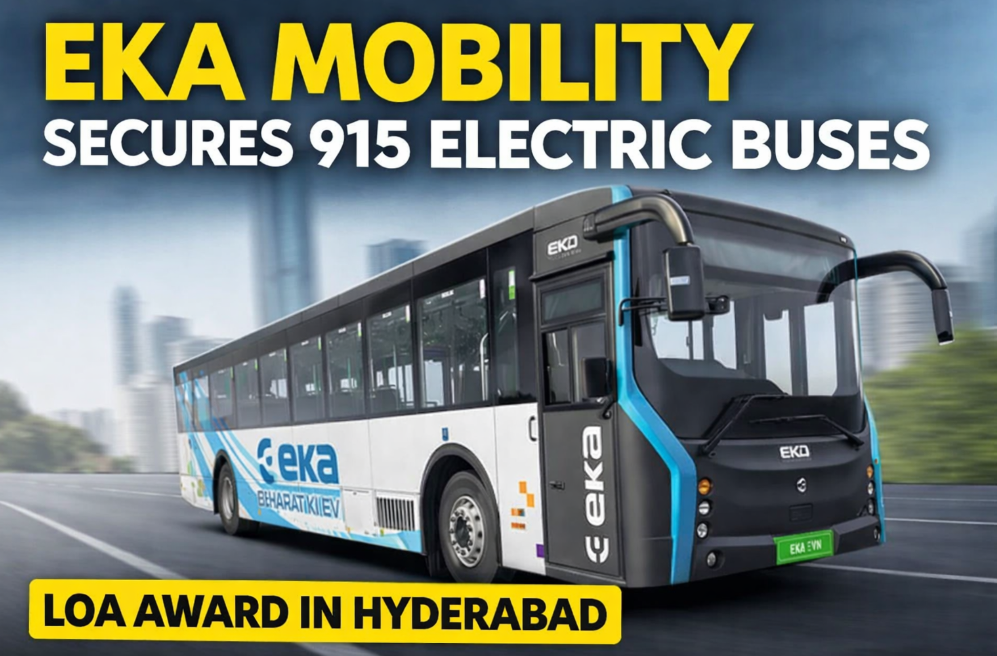
In a significant development for India’s electric public transport transition, EKA Mobility, in partnership with GreenCell Mobility, has secured a Letter of Award (LOA) for the supply and deployment of 915 electric buses in Hyderabad. The order has been awarded under the Government of India’s PM E-DRIVE scheme, which aims to accelerate the adoption of clean mobility solutions across urban transport networks.
According to official details, the order comprises a mix of 100 units of 9-meter electric buses and 815 units of 12-meter electric buses, all configured as non-AC variants. These buses will be deployed for city operations, targeting high-density urban routes where cost efficiency and scalability are critical.
The project is being executed as part of initiatives led by Convergence Energy Services Limited (CESL), a government-backed entity that is playing a central role in aggregating demand and enabling large-scale procurement of electric buses across India. CESL’s model focuses on reducing upfront costs for state transport undertakings while ensuring standardized deployment and operations.
Hyderabad, one of India’s rapidly expanding metropolitan cities, is expected to benefit from this large-scale induction of electric buses, particularly in terms of reduced emissions, lower operating costs, and improved fleet modernization. The deployment aligns with broader national goals of reducing dependence on fossil fuels and enhancing urban air quality.
For EKA Mobility, this order marks a notable expansion in its electric bus portfolio and reinforces its positioning in the public transport segment. Meanwhile, GreenCell Mobility continues to strengthen its role as a key operator in the electric bus ecosystem, focusing on end-to-end deployment and fleet management solutions.
The scale of this order also highlights the growing momentum behind government-led electrification programs. With multiple cities now adopting similar procurement models, the electric bus segment is expected to witness accelerated growth over the next few years.
As implementation progresses, timely delivery, charging infrastructure readiness, and operational efficiency will be key factors determining the long-term success of such large-scale deployments.