

Introduction
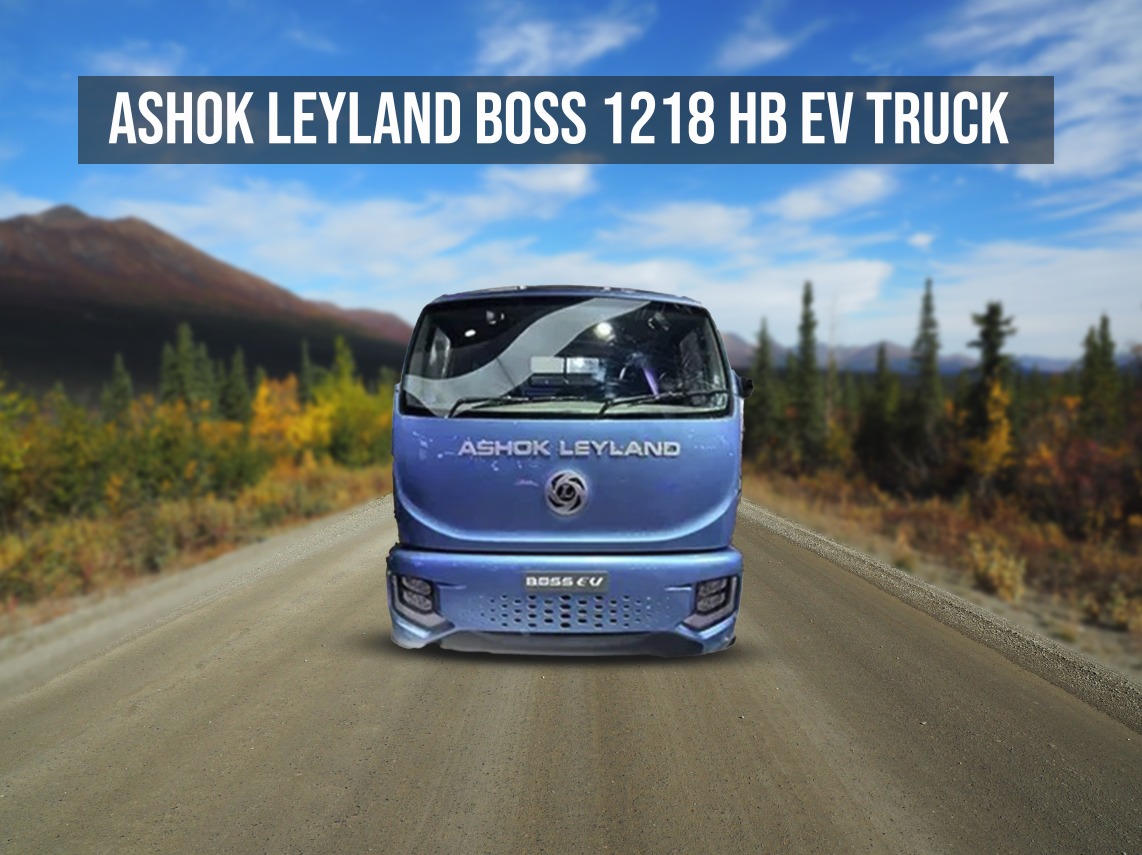
The Indian commercial vehicle market is steadily moving towards electrification, particularly in medium-duty segments where operating cost and regulatory compliance play a decisive role. The Ashok Leyland Boss 1218 HB EV from Ashok Leyland represents the company’s push into the electric haulage category, targeting urban distribution, industrial cargo movement, and inter-city applications.
This article provides a comprehensive analysis of the Boss 1218 HB EV truck’s mileage, range, performance, specifications, charging details, operating suitability, and competitive comparison.
Overview of Ashok Leyland Boss 1218 HB EV
The Boss 1218 HB EV is positioned in the medium-duty electric truck segment with a Gross Vehicle Weight (GVW) of approximately 11,990 kg. It is engineered to serve fleet operators seeking lower running costs and zero tailpipe emissions without compromising payload capacity or torque performance.
Key Specifications
| Specification | Details |
|---|---|
| Vehicle Category | Medium Duty Electric Truck |
| GVW | 11,990 kg |
| Payload Capacity | Approx. 5,000 kg |
| Motor Type | Permanent Magnet Synchronous Motor |
| Power Output | Around 187 HP |
| Peak Torque | Approx. 1,065 Nm |
| Transmission | Automatic (Single Speed) |
| Top Speed | Around 80 km/h |
| Drivetrain | Rear Wheel Drive |
Official brand reference:
https://www.ashokleyland.com
Mileage and Real-World Range
Unlike diesel trucks that are evaluated in km per litre, electric trucks are assessed based on range per full charge and cost per kilometre.
Claimed Range
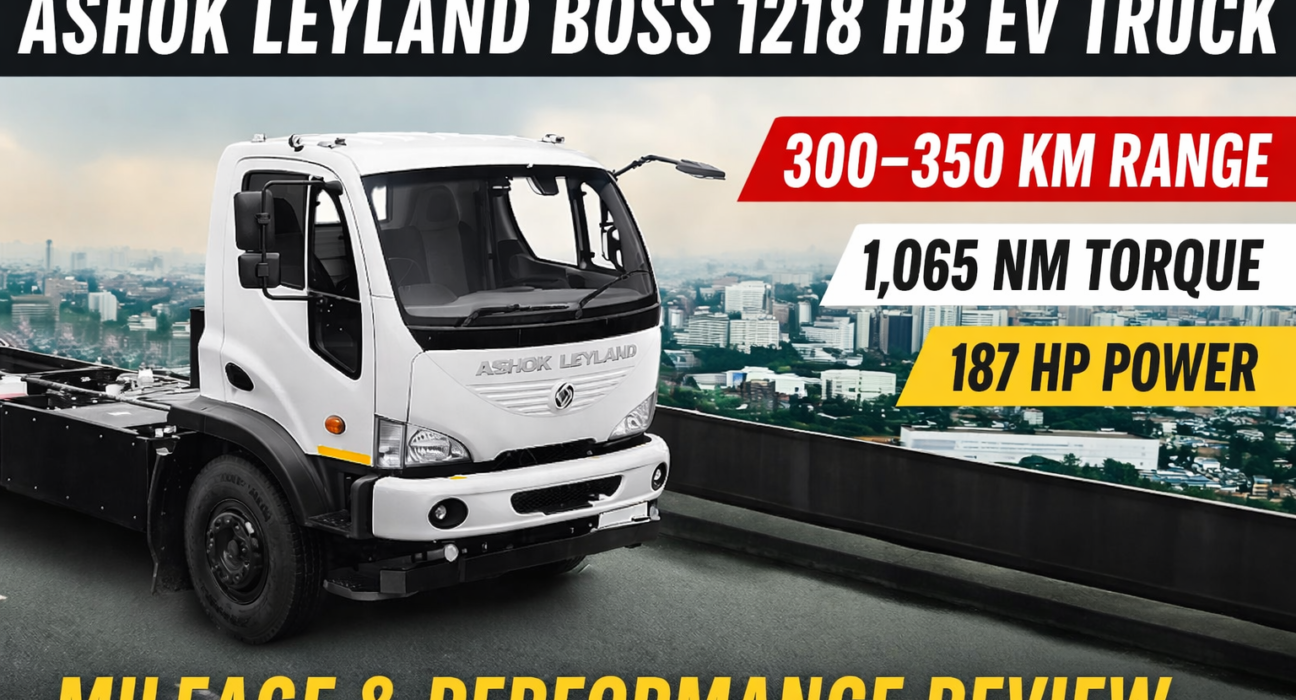
The Ashok Leyland Boss 1218 HB EV offers an estimated range of approximately 300 to 350 km per full charge under standard operating conditions.
Estimated Real-World Range Conditions
| Operating Condition | Expected Range |
|---|---|
| Light to Medium Load (City) | 300–350 km |
| Fully Loaded Urban Use | 270–300 km |
| Mixed Highway + City | 300–330 km |
Actual mileage depends on:
- Payload weight
- Driving behaviour
- Road gradient
- Traffic conditions
- Use of auxiliary systems
- Ambient temperature
For fleet operators running fixed daily routes under 250–280 km, this truck can operate without mid-day charging.
Performance Analysis
Motor Power and Torque
The truck is equipped with a high-output electric motor delivering approximately 187 HP and a strong peak torque of 1,065 Nm. The torque is available instantly, unlike diesel engines that require RPM build-up.
This makes the Boss 1218 HB EV suitable for:
- Frequent stop-start urban logistics
- Loaded starts on inclines
- Industrial and warehouse operations
- Distribution within city limits
The high torque ensures smoother acceleration even at higher payloads.
Charging Infrastructure and Time
Charging time depends on the charger type used.
| Charger Type | Estimated Charging Time |
|---|---|
| DC Fast Charger | Around 1 to 2 hours |
| AC Charging (Depot Based) | 4 to 6 hours (approx.) |
Fleet operators with depot charging setups can optimize overnight charging, reducing operational downtime.
Operating Cost Advantage
While exact cost per km varies by electricity tariffs, electric trucks typically offer:
- Lower energy cost per km compared to diesel
- Reduced maintenance due to fewer moving parts
- No engine oil, clutch, or gearbox maintenance
- Lower vibration-related wear
These advantages can significantly reduce total cost of ownership (TCO) over time.
Comparison with Competitors
To understand the Boss 1218 HB EV’s positioning, here is a comparison with other electric commercial vehicles, including Switch Mobility and selected diesel offerings from Tata Motors.
Specification Comparison Table
| Feature | Ashok Leyland Boss 1218 HB EV | Switch IeV Series (Light CV) | Tata LPK Series (Diesel) |
|---|---|---|---|
| Vehicle Type | Medium Duty Electric | Light Duty Electric | Medium Duty Diesel |
| GVW | 11,990 kg | Lower GVW Category | Higher GVW Variants |
| Range | 300–350 km | Lower Range | Depends on Tank Capacity |
| Torque | 1,065 Nm | Lower than 1218 HB | Engine RPM Dependent |
| Emissions | Zero Tailpipe | Zero Tailpipe | Diesel Emissions |
| Running Cost | Low | Low | Higher Fuel Cost |
| Ideal Use | Urban & Intercity | Last Mile Delivery | Heavy Duty & Long Haul |
Switch Mobility official website:
https://www.switchmobility.com
Tata Motors commercial vehicles:
https://commercial.tatamotors.com
The Boss 1218 HB EV stands out in the medium-duty electric segment where few full-scale haulage EV options are currently available.
Ideal Applications
The Ashok Leyland Boss 1218 HB EV is best suited for:
- FMCG distribution
- E-commerce logistics
- Industrial goods transport
- Urban cargo movement
- Fixed-route fleet operations
For fleet operators in metro cities and industrial corridors, this truck offers compliance with tightening emission norms and sustainability targets.
Strengths and Limitations
Strengths
- High torque suitable for heavy loads
- Competitive 300–350 km range
- Lower operational cost per km
- Automatic transmission
- Zero tailpipe emissions
Limitations
- Charging infrastructure dependency
- Higher initial acquisition cost compared to diesel
- Range variability under heavy load
Frequently Asked Questions (FAQs)
1. What is the mileage of Ashok Leyland Boss 1218 HB EV truck?
The truck offers approximately 300 to 350 km range per full charge, depending on load and driving conditions.
2. What is the torque output of the Boss 1218 HB EV?
It produces around 1,065 Nm of peak torque, suitable for loaded applications.
3. How long does it take to charge the truck?
With DC fast charging, it can take approximately 1 to 2 hours. Depot-based AC charging may take 4 to 6 hours.
4. Is it suitable for highway transport?
It is suitable for short to medium inter-city routes but is primarily optimized for urban and regional logistics.
5. How does it compare with diesel trucks?
Electric trucks offer lower running cost and zero emissions but have range and charging limitations compared to diesel trucks.
6. What is the top speed of Ashok Leyland Boss 1218 HB EV?
The top speed is approximately 80 km/h, suitable for commercial haulage.
Conclusion
The Ashok Leyland Boss 1218 HB EV truck represents a significant step in the electrification of India’s medium-duty commercial vehicle segment. With a claimed range of 300 to 350 km, strong 1,065 Nm torque output, and reduced operational cost, it is positioned as a practical solution for urban and regional freight movement.
For fleet owners operating predictable routes within 250–300 km per day, the Boss 1218 HB EV offers a compelling balance between performance, sustainability, and long-term cost efficiency. As charging infrastructure expands and policy incentives continue, electric trucks in this segment are expected to see accelerated adoption.