

Introduction
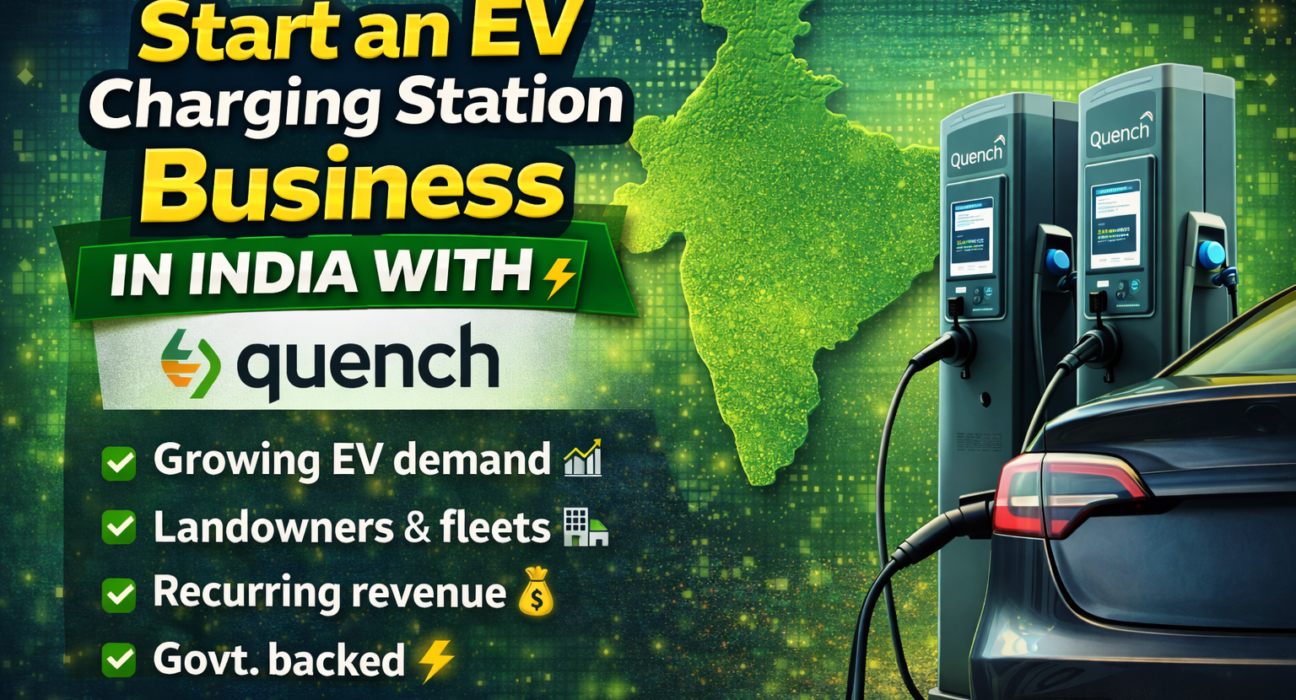
With electric vehicles rapidly increasing across India, EV charging infrastructure has become one of the most promising business opportunities today. From electric cars and two-wheelers to commercial EV fleets, the demand for reliable charging stations is growing faster than ever.
One company actively enabling this transition is Quench, a fast-growing Indian EV charging solutions provider that supports individuals, businesses, and fleet operators in setting up EV charging stations across the country.
This article explains how you can start an EV charging station business in India with Quench, including costs, business models, requirements, and profit potential.
Why EV Charging Station Business is a Big Opportunity in India
India’s EV ecosystem is expanding due to:
- Government EV policies and subsidies
- Rising fuel prices
- Fleet electrification (cabs, logistics, delivery)
- Growth in electric cars and two-wheelers
However, charging infrastructure is still limited in many areas, especially highways, industrial zones, commercial complexes, and semi-urban regions. This gap creates a strong opportunity for private EV charging station operators.
About Quench EV Charging
Quench is an Indian EV charging solutions company focused on:
- Public EV charging stations
- Commercial and fleet charging solutions
- End-to-end charging infrastructure deployment
Quench provides not just hardware, but also software, installation, backend management, and operational support — making it suitable for first-time EV charging business owners.
EV Charging Station Business Models with Quench
Quench typically supports multiple business models depending on your location and investment capacity.
1. Public Charging Station Model
- Install chargers at public locations (roadsides, malls, parking areas)
- Earn revenue per charging session
- Ideal for highways, cities, and busy commercial zones
2. Commercial / Workplace Charging
- Charging stations for offices, factories, warehouses
- Revenue through monthly contracts or usage-based billing
- Lower operational risk
3. Fleet Charging Model
- Dedicated charging for electric cabs, delivery fleets, logistics EVs
- High utilization and predictable income
- Growing demand from fleet operators
4. Landowner / Host Model
- You provide land or parking space
- Quench installs and operates chargers
- Revenue shared between you and Quench
Types of EV Chargers Offered by Quench
AC Chargers
- Power range: 3.3 kW to 22 kW
- Suitable for homes, offices, and two-wheelers
- Lower cost and easy installation
DC Fast Chargers
- Power range: 30 kW to 120 kW+
- Suitable for highways and commercial EVs
- Fast charging (30–60 minutes for cars)
Investment & Cost to Start EV Charging Station
Approximate Cost Breakdown (Indicative)
AC Charging Station
- Charger cost: ₹60,000 – ₹2 lakh
- Installation & electrical work: ₹50,000 – ₹1 lakh
- Total investment: ₹1.2 – ₹3 lakh per charger
DC Fast Charging Station
- Charger cost: ₹8 – ₹25 lakh
- Transformer & electrical setup: ₹5 – ₹15 lakh
- Civil work & approvals: ₹2 – ₹5 lakh
- Total investment: ₹15 – ₹45 lakh+
Actual costs depend on location, power availability, and charger capacity.
Space & Power Requirement
- Minimum space: 1–2 parking slots per charger
- Power connection:
- AC charger: Single/three-phase
- DC charger: Commercial high-load connection
- Location advantage: High footfall, easy vehicle access, safety, and visibility
Revenue & Profit Potential
Charging Revenue
- Average charging tariff: ₹12–₹20 per unit
- High-usage locations can generate consistent daily income
Monthly Earnings (Indicative)
- AC charger (moderate usage): ₹20,000 – ₹40,000 per month
- DC fast charger (high usage): ₹1 lakh – ₹4 lakh per month
ROI Timeline
- AC chargers: 12–24 months
- DC fast chargers: 24–36 months (depending on utilization)
Government Support & Policies
- EV charging is a de-licensed activity (no special license required)
- Many states offer:
- Subsidies on chargers
- Reduced electricity tariffs
- Capital support for public charging stations
Always check your state’s latest EV policy before installation.
How Quench Supports You
Quench typically provides:
- Charger selection & planning
- Installation & commissioning
- Charging management software
- Mobile app integration
- Billing and payment systems
- Maintenance and technical support
This reduces operational complexity for new business owners.
Who Should Start EV Charging Business with Quench?
- Landowners (roadside, commercial plots)
- Petrol pump owners
- Mall & hotel owners
- Industrial area operators
- Fleet owners
- Entrepreneurs looking for long-term infrastructure business
Challenges to Consider
- Initial capital investment
- Power availability in some areas
- EV adoption speed in your locality
- Charger utilization in early stages
Choosing the right location is the single most important factor for success.
Frequently Asked Questions (FAQ)
Is EV charging station business profitable?
Yes, especially in high-traffic areas and fleet-focused locations.
How much land is required?
As little as one parking slot for AC chargers; more for DC fast chargers.
Can I start with one charger?
Yes. Many operators start with a single charger and expand later.
Does Quench handle maintenance?
Yes, technical support and maintenance are part of their solution offering.
Is this business future-proof?
EV charging is long-term infrastructure aligned with India’s clean mobility goals.
Conclusion
Starting an EV charging station business with Quench is a practical way to enter India’s fast-growing EV ecosystem. With rising EV adoption, supportive government policies, and increasing fleet electrification, charging infrastructure will remain a critical and profitable sector for years to come.
For entrepreneurs, landowners, and businesses looking for a future-ready investment, EV charging stations offer a strong combination of stability, scalability, and sustainability.