

Introduction
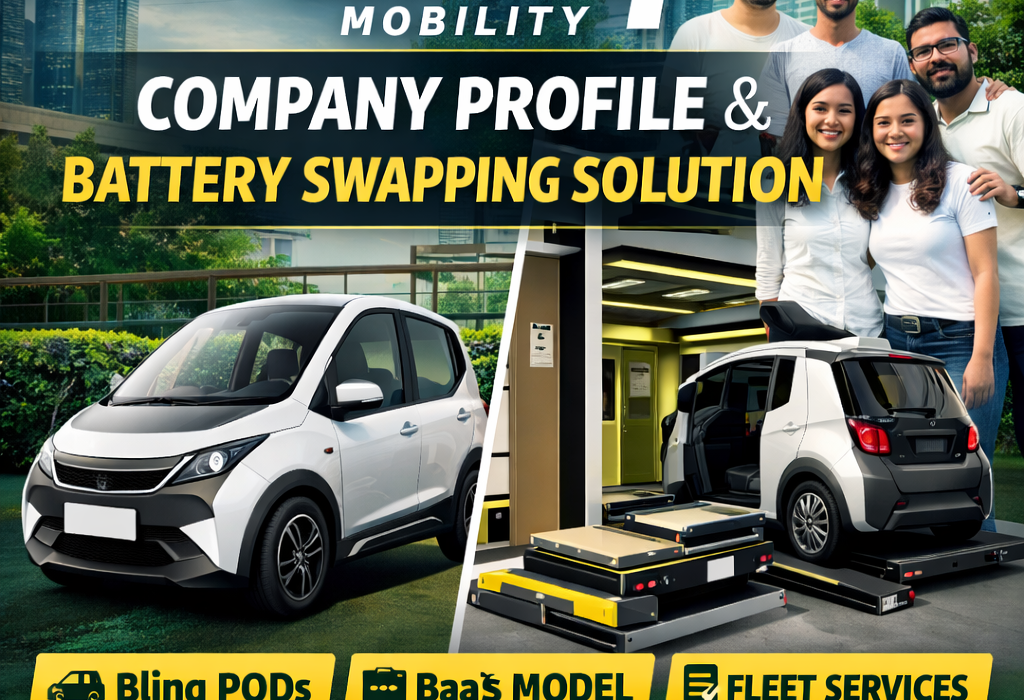
India’s urban mobility challenge is no longer just about electrification — it is about uptime, economics, and scalability. While many electric vehicle startups focus on private ownership or fast-charging narratives, Blinq Mobility has taken a different route: building a fleet-first urban electric vehicle ecosystem powered by battery swapping and Battery-as-a-Service (BaaS).
Founded in 2024 and headquartered in Gurugram, Haryana, Blinq Mobility is developing Blinq Pods, compact electric city vehicles designed specifically for ride-hailing, shared mobility, and high-utilization fleet operations.
Official website: https://www.blinqmobility.com/
About Blinq Mobility (Company Overview)
- Founded: 2024
- Headquarters: Gurugram, Haryana, India
- Industry: Electric Vehicle Manufacturing & Urban Mobility
- Team Size: 11–50 employees
- Backed by: IIMA Ventures, ARAI-AMTIF, Deshpande Startups, FIIRE Goa, Startup Nexus
Blinq Mobility’s mission is to make EVs the default mode of urban commute by solving the real adoption barriers faced by drivers and fleet operators — charging downtime, battery cost burden, and range anxiety.
Founders & Engineering Background
Blinq Mobility was founded by Nikesh Bisht, Ankit Kumar, Abhilasha Marmat, Sushmita Patil, and Yashdeep Singh.
The founding team shares a strong engineering background as members of IIT Delhi’s AXLR8R Formula Student electric racing team.
This motorsports experience shaped Blinq’s engineering philosophy:
- Designing EVs from scratch
- Building for durability, not demos
- Optimizing performance under constraints
- Treating reliability and uptime as core metrics
Instead of transitioning racing EVs into premium consumer cars, Blinq redirected this experience toward urban commercial mobility, where efficiency matters more than speed.
What Problems Blinq Mobility Solves
Urban EV fleets typically face three major challenges:
1. Charging Downtime
Traditional plug-in EVs remain idle for hours during charging, reducing daily utilization.
2. High Vehicle Cost
Batteries contribute 30–40% of an EV’s total cost, locking capital and increasing financial risk.
3. Driver Range Anxiety
Unpredictable range impacts trip acceptance and fleet productivity.
Blinq Mobility’s products and services are designed to eliminate all three simultaneously.
Blinq Pod: Product Overview
What Is the Blinq Pod?
The Blinq Pod is a compact, lightweight, four-wheeler electric city vehicle built specifically for urban fleet use.
Key Design Highlights
- Skateboard platform architecture for modularity and low center of gravity
- Composite body construction for strength, corrosion resistance, and weight reduction
- Compact footprint suited for congested Indian cities
- Spacious, air-conditioned cabin focused on passenger comfort
- Advanced braking system with ABS
Intended Applications
- Ride-hailing fleets
- Shared urban mobility
- First-mile / last-mile passenger transport
- High-frequency city operations
The Blinq Pod is not positioned as a private consumer EV, but as a commercial mobility asset.
BlinqSwap: Battery Swapping Technology Explained

How BlinqSwap Works
- Drive In: Vehicle enters the BlinqSwap station
- Smart Alignment: Automated guidance aligns the pod
- Battery Swap: Depleted battery removed and replaced
- Drive Out: Vehicle exits with full usable range
Core Metrics
- Swap time: Less than 5 minutes
- Usable range per swap: ~250 km
- Operation: Fully automated, no long queues
This system is designed to replace charging downtime with near-continuous vehicle operation.
Battery-as-a-Service (BaaS) Model
Blinq Mobility separates the vehicle from the battery, offering batteries as a service rather than a purchase.
Benefits for Fleet Operators
- Lower upfront vehicle cost
- No battery degradation risk
- Predictable operating expenses
- Guaranteed battery health
- Simplified fleet accounting
This model shifts fleet economics from high CAPEX to controlled OPEX, improving ROI.
Fleet Economics & Operating Impact
Based on Blinq’s published operating assumptions:
- Daily distance: ~200 km per vehicle
- Uptime: 16–20 hours per day
- 10-vehicle fleet:
- Approx. ₹43–44 lakh annual savings
- ~87,600 kg CO₂ eliminated annually
- 100-vehicle fleet:
- ₹2+ crore annual savings
- ~8.7 lakh kg CO₂ reduction
Savings come from:
- Zero charging downtime
- Higher trips per day
- Lower energy & maintenance cost per km
Services Offered by Blinq Mobility
Blinq Mobility operates as a full-stack fleet mobility partner, not just a vehicle OEM.
Key Services
- Fleet vehicle supply (Blinq Pods)
- Battery swapping infrastructure deployment
- Battery subscription (BaaS)
- Predictive maintenance & vehicle monitoring
- Fleet analytics & uptime optimization
- Pilot programs & phased fleet scaling
Pricing & Cost Structure (Important Clarification)
Blinq Mobility does not publish fixed retail pricing on its website.
How Pricing Is Typically Structured
- Vehicle cost (without battery)
- Battery subscription fee (BaaS)
- Swap energy / usage charges
- Infrastructure & depot setup (if applicable)
Final pricing depends on:
- Fleet size
- Daily usage (km/day)
- City & swap-station density
- Contract duration
Fleet operators must request a custom commercial proposal.
How to Buy or Avail Blinq Pods
Fleet onboarding typically follows this process:
- Initial inquiry via official website
- Fleet requirement discussion (city, routes, km/day)
- Pilot deployment (small fleet)
- Performance & cost validation
- Commercial rollout & scaling
Official Contact Details
- Website: https://www.blinqmobility.com/
- Email: info@blinqmobility.com
- Address:
169, Sikandarpur Badha, Sector 85,
Gurugram, Haryana – 122004
Where Blinq Mobility Makes the Most Sense
Best Fit
- Dense urban cities
- Ride-hailing & shared mobility fleets
- High daily utilization vehicles
- Operators focused on uptime & ROI
Not Ideal (Currently)
- Private individual buyers
- Rural or highway-heavy usage
- Low-utilization vehicles
Final Verdict
Blinq Mobility is addressing one of the hardest problems in India’s EV transition — fleet uptime and economics.
Its combination of battery swapping, BaaS, and purpose-built urban vehicles positions it as a serious contender in the shared mobility space.
Execution, swap-network expansion, and long-term reliability will determine scale — but the problem-solution fit is strong and relevant.
FAQs
Is Blinq Mobility a vehicle manufacturer or a mobility service provider?
Blinq operates as both — manufacturing vehicles and providing battery swapping and fleet services.
How long does a Blinq battery swap take?
Less than 5 minutes.
Is Blinq available for individual buyers?
Currently focused on fleet and commercial customers.
Does Blinq sell batteries with the vehicle?
No, batteries are provided under a Battery-as-a-Service model.
Where is Blinq Mobility located?
Gurugram, Haryana, India.