


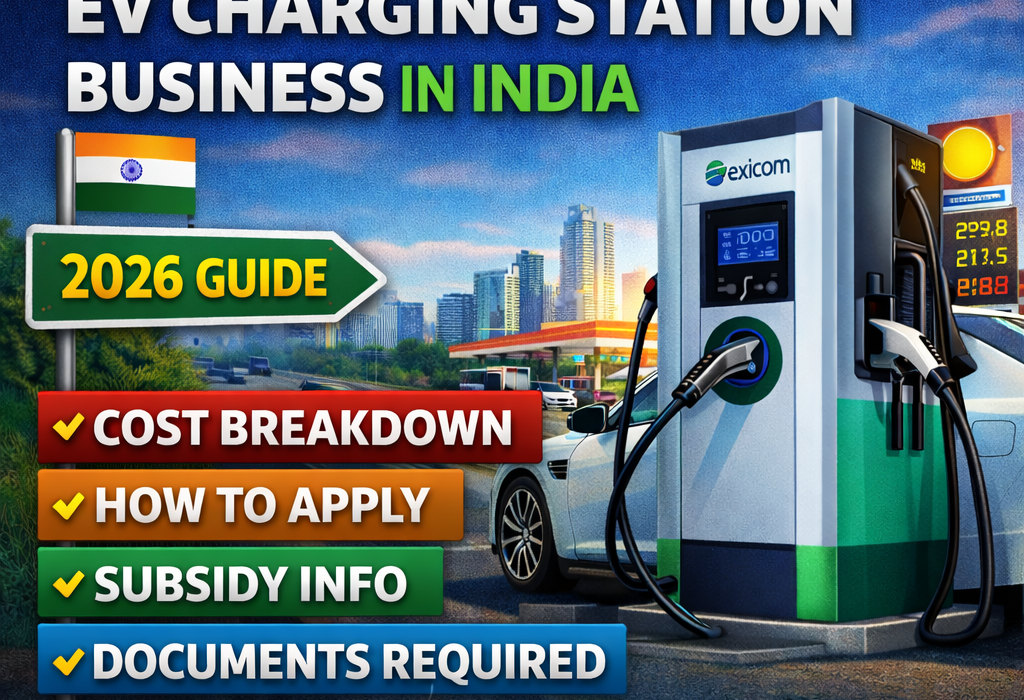
As EV adoption accelerates across India, charging infrastructure is shifting from “pilot projects” to serious infrastructure businesses. One company that consistently appears in large-scale public and fleet charging deployments is Exicom.
This article explains how Exicom fits into the EV charging business, what it costs to deploy Exicom chargers, how to apply, subsidy clarity, required documents, and common questions — without marketing hype.
Who is Exicom in EV Charging?
Exicom is an Indian power electronics and EV charging solutions provider with a strong presence in:
• DC fast chargers for public charging
• Fleet and depot charging solutions
• Utility-scale and institutional projects
• Charger manufacturing and backend integration
Exicom is widely used in government-backed charging projects, PSU deployments, and large charging networks due to its India-focused design and service approach.
Exicom EV Charger Portfolio (India)
AC Chargers
Best for offices, depots, long parking duration.
• 7.4 kW
• 11 kW
• 22 kW
Use case:
✔ Overnight fleet charging
✔ Commercial parking
✔ Corporate campuses
DC Fast Chargers
Best for public charging, highways, fast turnaround fleets.
Common power ratings deployed in India:
• 30 kW
• 60 kW
• 120 kW
• Higher-capacity multi-gun systems (site dependent)
Connector standards typically include:
• CCS2
• Bharat DC (for legacy compatibility where required)
Where Exicom Charging Stations Work Best
Exicom chargers are commonly installed at:
• Highways and expressways
• Fuel stations
• City public charging hubs
• Bus depots
• Fleet yards (cars, 3W cargo, mini trucks)
• Government and PSU sites
Their strength lies in high-uptime public infrastructure rather than residential or hobbyist setups.
Cost Breakdown: Exicom EV Charging Station Setup (Reality)
Important truth:
Charger cost is only one part of the project. Power infrastructure dominates DC fast charging economics.
Option 1: AC Charging Setup (Depot / Commercial)
Typical setup
• 5 to 10 AC chargers
Cost components
• AC charger hardware: ₹0.8 – 1.6 lakh per charger
• Electrical panels, cabling, earthing: ₹1.5 – 3 lakh
• Load upgrade (if required): ₹2 – 5 lakh
• Civil work & installation: ₹1 – 2 lakh
• Software / monitoring (optional): ₹0.5 – 1 lakh
Total realistic investment
👉 ₹9 lakh to ₹18 lakh
Best for:
Factories, warehouses, EV mini-truck depots, corporate fleets
Option 2: 30–60 kW DC Fast Charger (City / Fleet)
Cost components
• DC charger hardware: ₹12 – 25 lakh
• Transformer / HT or LT upgrade: ₹6 – 12 lakh
• Electrical safety & protections: ₹2 – 4 lakh
• Civil foundation & installation: ₹2 – 3 lakh
• Backend, networking & commissioning: ₹1 – 2 lakh
Total realistic investment
👉 ₹25 lakh to ₹45 lakh
Best for:
Urban public charging, taxi fleets, fast turnaround depots
Option 3: 120 kW+ DC Fast Charging Station (Highway)
Cost components
• DC charger hardware: ₹28 – 45+ lakh
• HT connection & transformer: ₹10 – 25 lakh
• Civil, safety, fire compliance: ₹3 – 6 lakh
• Backend, metering, commissioning: ₹2 – 4 lakh
Total realistic investment
👉 ₹45 lakh to ₹1 crore+
Best for:
Highways, expressways, fuel station partnerships
How to Apply for Exicom EV Charging Station (Step-by-Step)
Step 1: Define Your Use Case
Decide clearly:
• Public charging or fleet charging
• AC only or AC + DC
• City or highway location
Step 2: Power Feasibility Check
Assess:
• Existing sanctioned load
• Requirement for LT vs HT connection
• Space for transformer and panels
(This step decides 60% of project cost.)
Step 3: Contact Exicom (Official Route)
You can apply or request deployment support via Exicom’s official EV charging solutions contact page.
👉 Official website:
https://www.exicom-ps.com
(Use EV charging or contact section to submit inquiry.)
Step 4: Proposal & Commercial Model
Exicom or its partners may offer:
• Hardware supply only
• Turnkey EPC deployment
• PSU / utility-linked implementation
Commercial structure depends on:
• Location
• Volume
• Project type
Step 5: Installation & Commissioning
Includes:
• Electrical safety checks
• Charger testing
• Backend integration
• DISCOM inspection (if required)
Subsidy & Government Support (Reality Check)
Key policy truths
• EV charging is an unlicensed activity in India
• No special central license required
• Compliance with DISCOM, safety, and local norms is mandatory
PM E-DRIVE & Public Charging Support
Government support exists for public EV charging infrastructure through national and state schemes.
Important clarification:
• Subsidy is not automatic cash payment
• Support is routed through eligible entities and approved programs
• In many Exicom projects, benefits are embedded via PSU or utility-led deployments
Private landowners usually do not receive direct subsidy cash, but may benefit indirectly through reduced capex or shared infrastructure.
Documents Required (Typical)
• Applicant ID & business documents
• Land ownership or lease agreement
• Site layout and photographs
• Latest electricity bill
• Load sanction or enhancement application
• Electrical single line diagram (SLD)
• Local NOC if required
Exact documents vary by state and DISCOM.
Frequently Asked Questions (FAQs)
Is Exicom suitable for public charging stations?
Yes. Exicom is widely used in public and PSU-led charging networks and supports high-capacity DC fast charging.
Is Exicom a franchise model?
No. Exicom is a charger OEM and solution provider, not a franchise operator.
Which Exicom charger is best for fleet depots?
Most fleets use:
• AC chargers for overnight charging
• One 30–60 kW DC charger for quick top-ups
Does Exicom support CCS2?
Yes. Exicom DC chargers commonly support CCS2 and Bharat standards where applicable.
Can individuals apply for Exicom charging stations?
Yes, provided land, power availability, and commercial feasibility exist.
What is the biggest hidden cost?
HT connection and transformer upgrades — often underestimated by first-time investors.
EV Charging Station Business in India: Why 2025 Is the Turning Point - EV Truck India
December 27, 2025[…] Exicom EV Charging Station Business in India: Cost,… […]